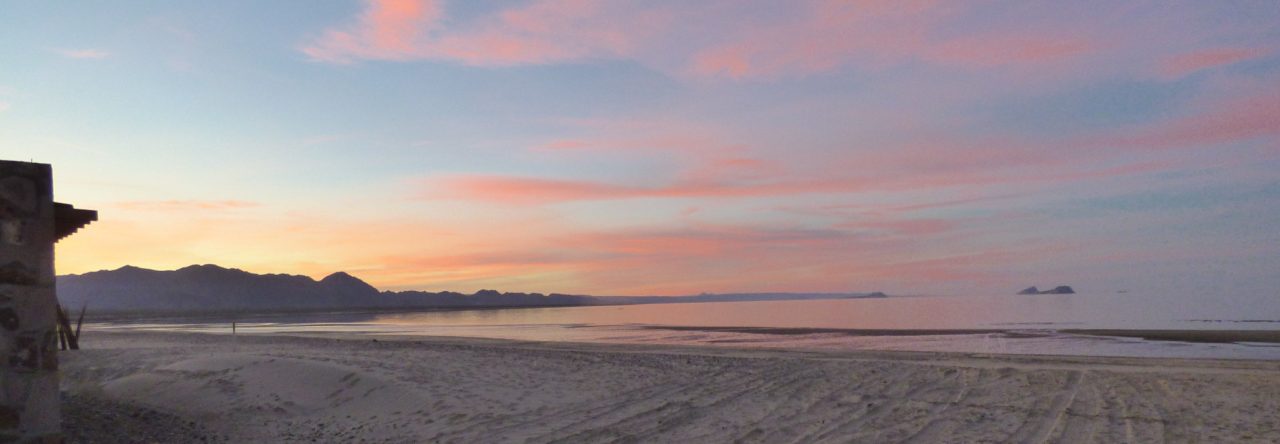
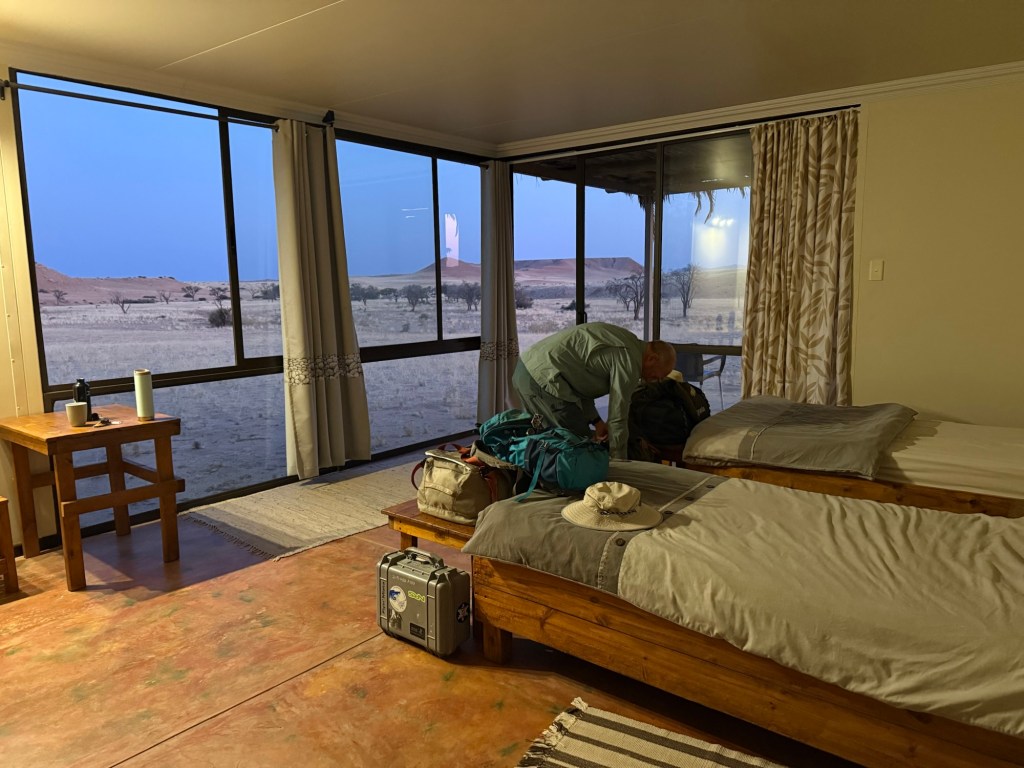
The morning after our game drive, we were treated to a late departure from Hammerstein Lodge, somewhat compensating for our early-start, long day, the day before. We passed through the town of Solitaire, enjoying some of its legendary Apple pie, before arriving at Boesman’s Camp for our final day in the Namibian desert. It was dry, and hot.


in Solitaire
After checking into our rooms, we met for a guided tour led by a local expert by the name of Franz, with Sossus-on- Foot Desert Tours. Loading up on another open-air 4×4 safari vehicle, Franz at the wheel, we headed north, out into the Namib desert.
After a few miles, Franz nearly leapt out of the drivers seat, barefoot, coming around to one side of the vehicle to address our group. He jovially asked us if any of us spoke bushmen’s English, laughing as we looked back at him with silent, puzzled stares. He explained that while his native language uses a lot of clicks with the tongue, he politely and jovially asked us to tell him if we didn’t understand – and he would slow down, and try again. I instantly loved the rhythmic, melodic sound of his voice.
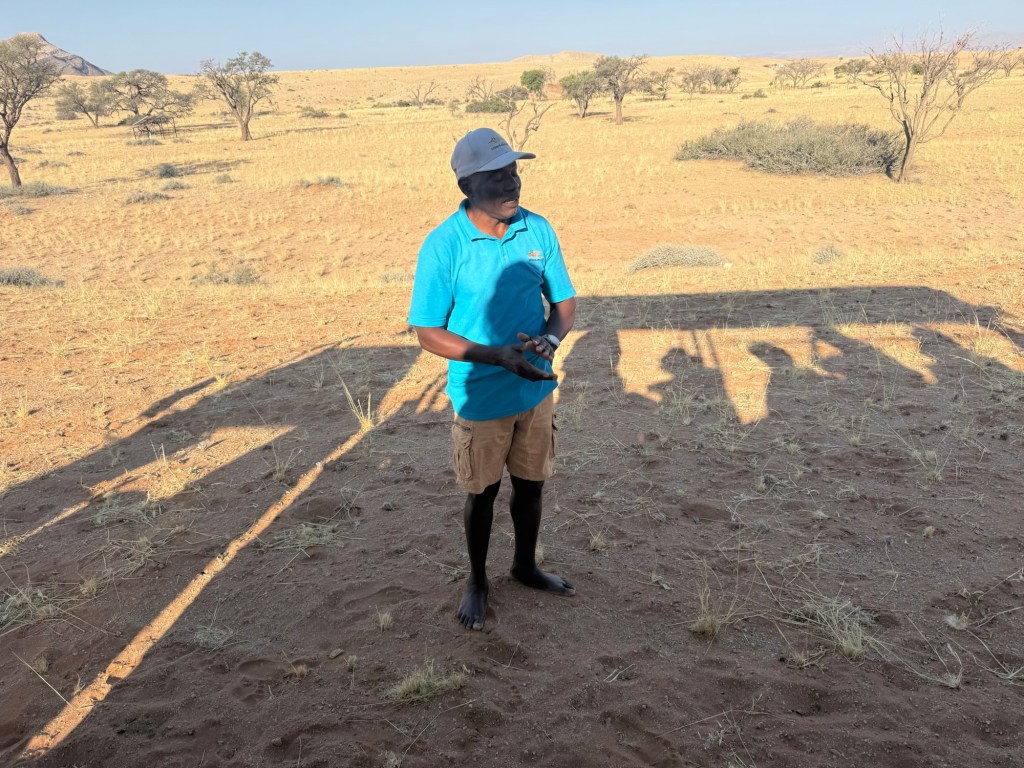
From Franz we also learned that the term “Bushmen” was once, and to some still may be, offensive. He said they are the San, or Khoisan, people. They don’t come from the bush. His people believe that all things come from the moon. He acknowledged, however, that the term “bushmen” is more familiar to many, and used it throughout his talk, likely because he wanted to facilitate our understanding of what he was saying.
Franz began by characterizing this section of the Namibian desert – on average, this area receives 2mm of rain per year. If they are lucky, he said, it might see 5mm – when this happens, there is easily enough for his people and their food sources to survive. But, he stressed many times throughout the tour, the weather is changing – in 2022, this area received 45mm of rain in a single year. That year, the dry river bed that we were driving along, which the elders say last had water in 1950, ran with water four times. At the same time, they are drilling deeper and deeper for water: years ago, but within his lifetime in this area water was found at 200m. The most recent well was drilled at 230m deep.
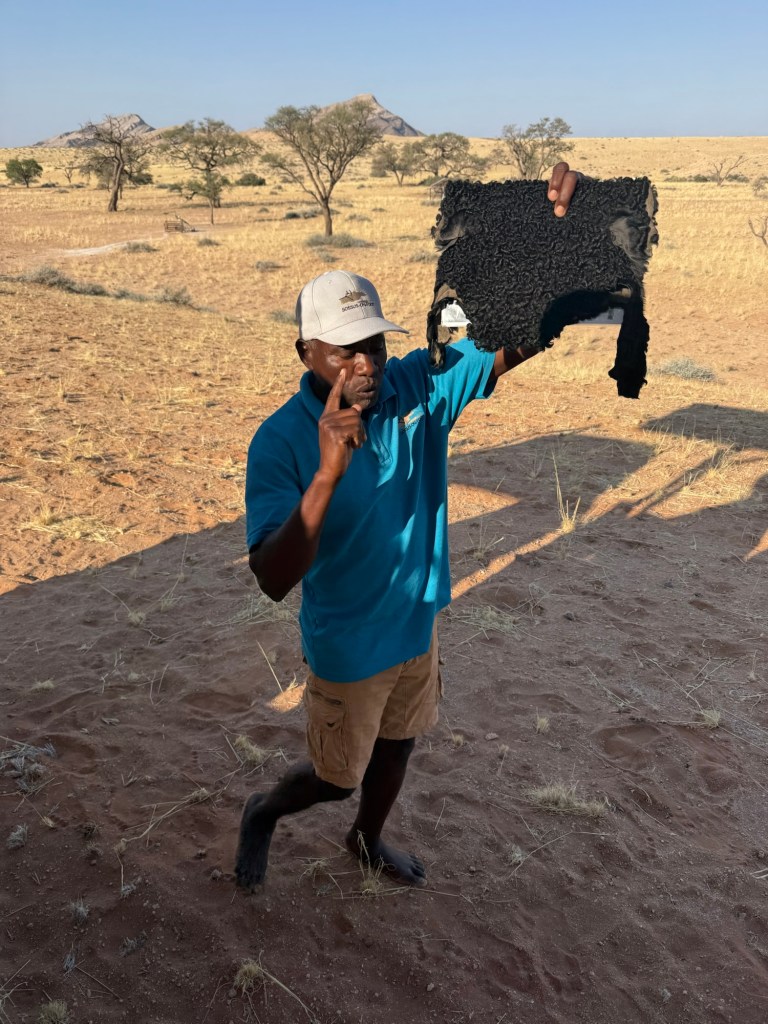
Why settle here, then? Franz addressed this unspoken question by telling us about German farmers who settled here in the early 1900s, and began raising a type of sheep whose lambs are born with an incredibly smooth, luxuriously shiny, black pelt. According to Franz, the hotter and drier the conditions during the mother’s gestational period, and the more difficult the mother’s labor, the better quality of the lambs pelt at birth. If the lambs are slaughtered within eight hours of their birth, the German farmers knew that these pelts would fetch a high price by high-end, exclusive fashion designers.
However, after some years, as the public learned about the conditions and means by which these lamb pelts were obtained, people concerned for the welfare of these animals took to the streets in protest. When they came upon someone proudly wearing an article of clothing sourced from these newborn lamb pelts, they sprayed the garment with brightly-colored spray paint, ruining the item. The market for these pelts collapsed in a matter of years, the farms’ viability destroyed.
Over time, however, Franz said that a tourist economy has developed here – and a 1,300 hectare property that could once be purchased for 500 Namibian dollars now goes for in excess of a million. Safari guest lodges, like the Boesman’s Camp where our group is spending the night, as well as others far more exclusive and glamorous, are drawing visitors from around the world.
Coming to an area in which the wire fencing was laying down, it’s posts pulled out of the ground, Franz explained that fences still mark property lines, but are no longer maintained (in an upright position) because property owners want to facilitate animal migration. This helps to ensure large, viable herds of many species which is good for hunting, which everyone benefits from – including those involved with the growing tourist economy.
Speaking to the human relationships here, Franz informed us that in 1915, it was legal for other people to kill the San people (bushmen) with a permit. This grew from San people killing farmers’ livestock. Franz explained that such actions on the part of the San people were neither malicious nor disrespectful – having lived in this desert for generations, these highly nomadic people simply did not understand the concepts of fences, property lines and exclusive land ownership. Their ignorance proved deadly, to many.
Franz went on to say that the San people of the Namib desert were historically short in stature, maybe 1.5m at most in height, with yellowish brown skin. However, as they have begun to mix with other, darker skinned Africans, they are becoming taller, and darker.
He acknowledged the common lore about San people being able to smell and find water over great distances 10, 20, even 70 km away. Not so. They are tracking animals to water.
Here, summer high temps can reach 55 degrees Celsius. Human can die within hours. Due to the presence of black iron oxide, surface temperatures of the sand can exceed 80 degrees C.
Incidentally, high iron oxide in some sand deposits interferes with most compasses – making them useless. Yet, the San people orient themselves by the wind ripples in the sand, which change seasonally with the direction of the prevailing winds. San people do not get lost in the desert, he insisted.

Franz also gave us a bit of a language lesson, telling us that “Sossus” in Namibian means “to disappear in the sand”. So, the name “Sossusvlei” means “the place where things [people, animals, landscape features] disappear into the sand”.
According to Franz, the sand here originates from the Kalahari Desert, where winds carry it to the Orange River valley, forming the Namib Desert, before carrying it further out to the sea. He drew us maps in the sand beneath his feet, illustrating that the Sossusvlei Dunes we visited just days ago are primarily in a north south orientation, due to direction of east-west prevailing winds, which carry sand back and forth, depositing it in extensive dunes.
As a result of this process, over thousands of years, the desert is expanding inland. The dunes are growing, as sand continues to accumulate between dunes, eventually connecting existing dunes and forming dams, which then hold back water as it runs down from the mountains. According to Franz, this leads to the formation of oasis areas, like the one at the Park entrance we went through – where the water table is higher and more vegetation can grow.
Franz informed us that this desert has over 130 species of beetle, and seven species of spider. He emphasized that people tend to get bitten – whether by spiders, nettles, snakes, or whatever – because we panic when they come near, or on, us. Just let them be, they will move on. I remembered Erasmus’ similar instruction, during our game drive to see the white rhinos. Once again, easier said than done!
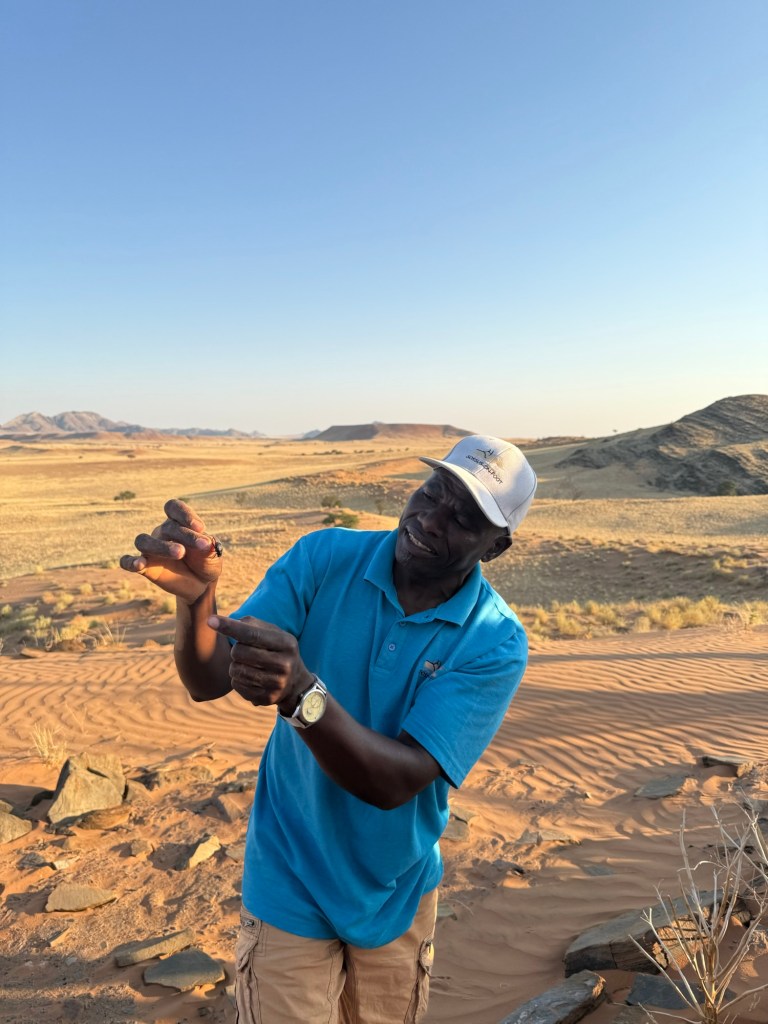
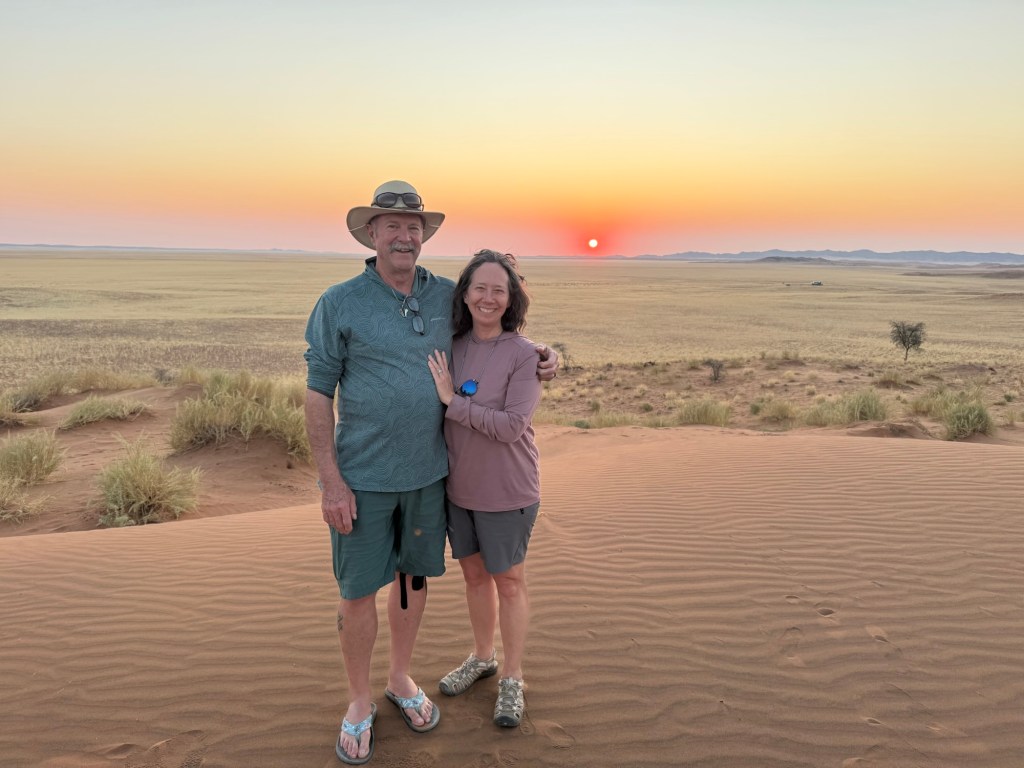
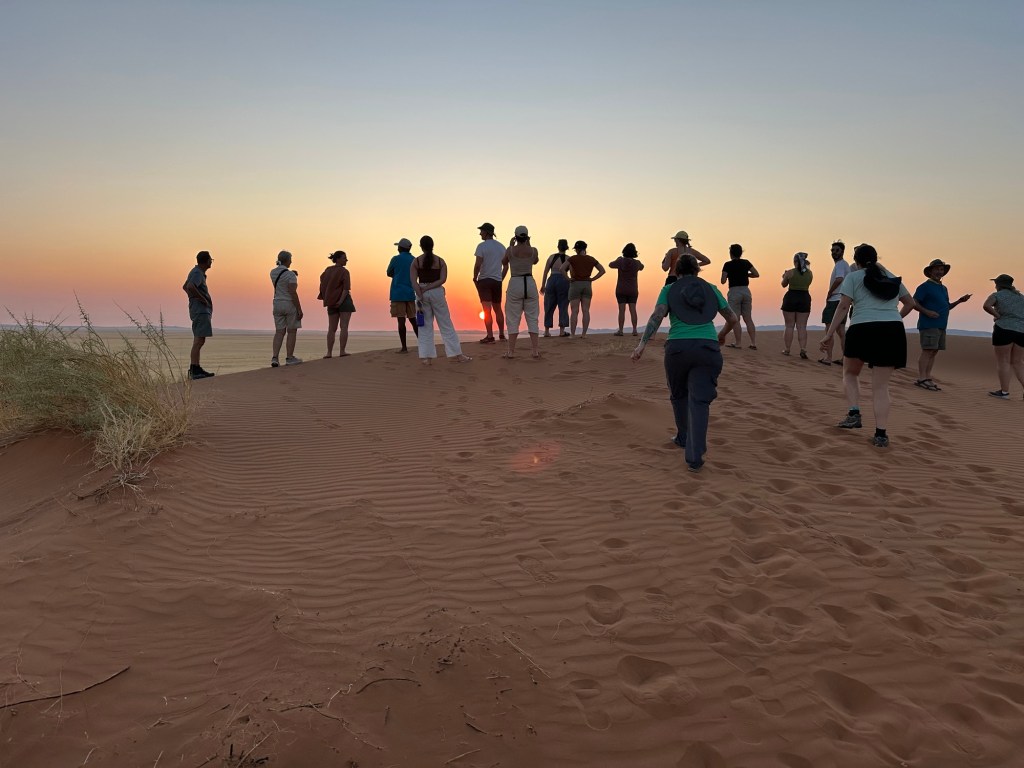
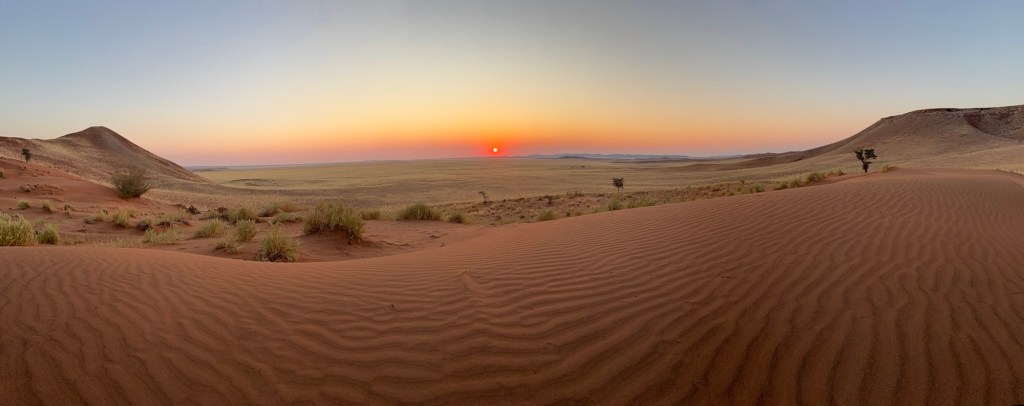
We ended our tour with a short scramble up a hillside, to watch the sunset off in the distance. Here, Franz answered our many questions about the future of the San people, and the landscape here, as property values skyrocket, displacing the many native Africans as well as descendants of European colonizers who settled here in the early parts of the last century. Change, Franz insisted, is constant. We must continue learning to how to live with it, and each other.
A pearl of wisdom from a San man of the Namib Desert.


wonderful! Thank you for sharing.
LikeLiked by 1 person