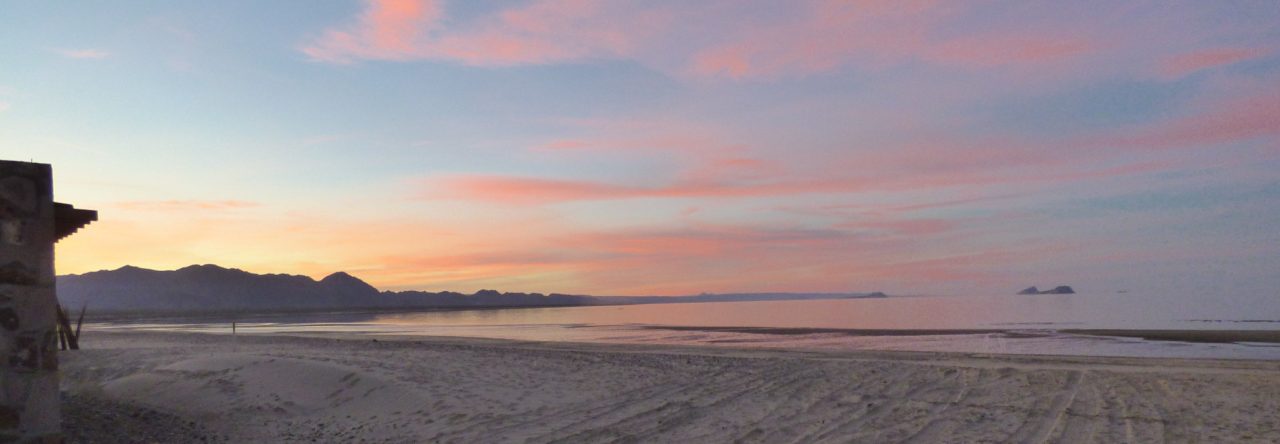
We decide to head south toward the gray whales at the recommendation of our friends Ross and Kate, who have done the scouting for us, having left Punta Bufeo a week or so prior to allow JD and me to recover from the flu. A week or so after Ross and Kate’s departure, we are joined by friends Lee and Kathy, who have driven all the way from their hometown of Chesterton, Indiana in a mere four days. Kathy, having lost her mom a few weeks prior, is grieving; the day they arrive is also her mother’s birthday. We hug each other tight and are happy that they have chosen to come rest with us awhile, after the long and emotional journey through helping a beloved parent leave this world.
After a few days, we load up our truck campers and prepare to head south. Before we leave, I make one more phone call to my parents to check in; a few weeks ago my dad took a fall, breaking his elbow. After a brief scramble, my sister flew home to see dad and mom through the surgery to install plates in his arm. Dad made it through, again demonstrating the appropriateness of his family nickname, “the energizer bunny” – for his endurance through countless health struggles of his own, and now as primary caregiver for my mom. When I call, dad answers in an upbeat tone, telling me jovially that he is “supervising” while Betty, the caregiver that we hired at Thanksgiving, and mom make the beds in their house. My heart lifts to hear the lightness in his voice: the man is in a sling, having suture bandages changed daily by nurses, unable to drive, home bound with his wife of 50 years. And yet, he smiles. He laughs. He somehow manages to find something to enjoy most days, and share it with those around him. He is teaching me so much about resilience, love, devotion, service, and the roots of happiness.
I tell dad of JD and my plans to go see the whales; he listens eagerly, clearly excited for us and our adventure. Dad, who nurtured my love of nature as a child, taking me camping and sharing his National Geographic magazines with me, asks me to send him pictures. I tell him I will, realizing once again that he is asking me to help him live vicariously through me. Mom, who is listening but no longer capable of tracking most conversations, waits for a lull and asks about the weather “where you are”, the one question she asks with regularity, adeptly phrased in an effort to conceal the fact that she doesn’t know where I am, although I tell her every time that I call home.
The route from Punta Bufeo south on MX-5 to its junction with MX-1 at Lake Chapala is now paved all the way. This means a journey that took us some four hours last May can now be completed in less than an hour! We arrive at the turnoff for Bahia de Los Angeles in a mere 80 minutes, and continue onward on MX-1, now taking me further south than I’ve ever been on the Baja peninsula. JD has been down this road before, on his transcontinental motorcycle trip to Ushuaia, at the tip of Argentina, some 11 years ago. Meanwhile, I savor every mile of this new landscape. The Baja desert is verdant – Cardon, Cirio, mesquite, Palo Verde, Ocotillo (or Palo Adan? I still am not sure), organ pipe and Old Man’s beard and cholla cacti cover the hillsides with myriad shades of green. Desert mallow dots the roadsides with vibrant shades of apricot, interspersed with stands of glorious purple lupine. There is water in the normally dry lakebed of Lake Chapala. Eventually, the road turns west toward the Pacific Ocean; we cross into Baja California Sur, and enter the small village of Guerro Negro, where we enjoy a late lunch of lobster and margaritas, at Marios.
While at lunch, we get a phone call from Ross, and firm up our whale watching plans. Ross recommends that we head for Ojo de Liebre, so we hit the road again. Some 20km south, we find the turnoff. After a short stretch of pavement, the road turns to gravel, then well-graded dirt. We pass a sign declaring simply: “Zona de Neblina” – zone of fog (a new Spanish word for me!). The vegetation transitions from cirio and cactus to flat, sand dune topography. After many isolated miles, we approach a manned guard station, where we pay $10 to enter the federally protected area of Ojo de Liebre. We ask the security guard if we are headed toward Ojo de Liebre; he says with a smile, and hand gestures, “si! Derecho, decrecho….” (yes! Straight, straight….).
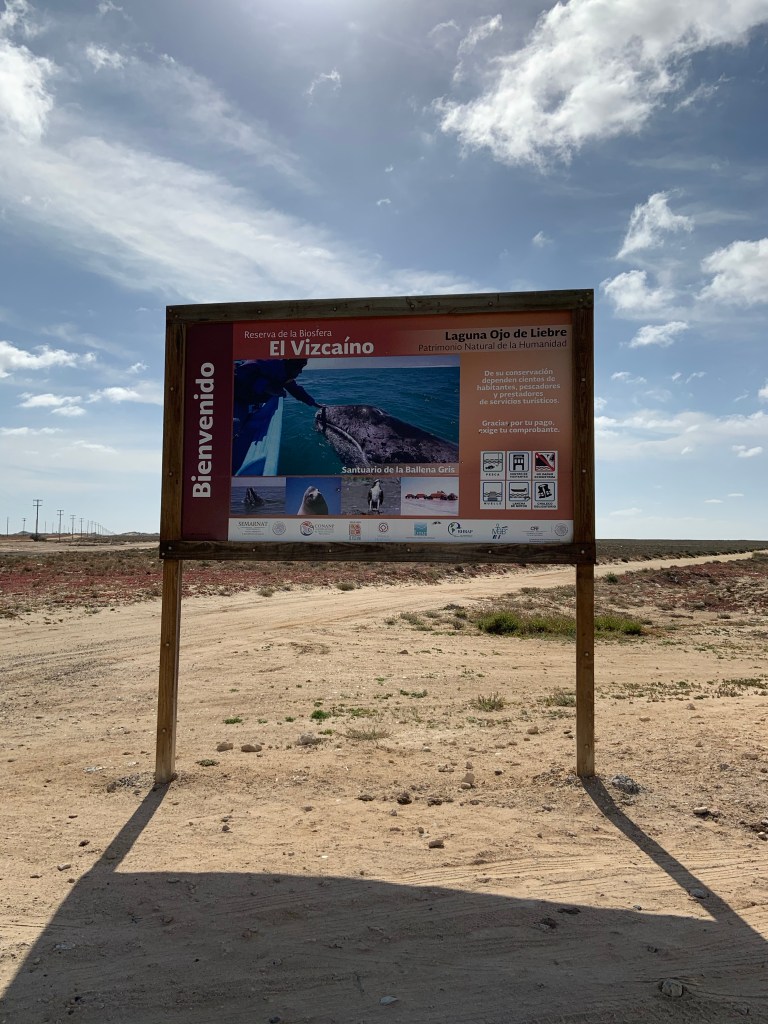
Initially, upon leaving the guard station, we drive through an impressive array of saltwater ponds and canals lined by berms and heavy machinery, at the edges of the water are piles of accumulated salt, some several feet tall. I learn later that this is the site of the largest commercial saltworks plant in the world. We continue straight for some time, and at long last the Pacific Ocean comes into view, as we approach the El Vizcaino Whale Sanctuary. Turning right, we approach a second guard station, clearly signed as the Mexican Home of the Gray Whales. Another security guard, shirt bearing the name “Leonardo”, welcomes us. For a mere $10/night, we can camp here, anywhere along the next 3km of dirt road paralleling the lagoon.
We drive to the end of the dirt road, admiring the well-kept campsites and signs indicating “do not drive off road,” “do not throw trash”, “camp only in designated campsites”, and “no entry, closed for restoration”. This place is obviously well loved and maintained, with pride. The palapas are generously sized, and swept clean; the campsites are similarity large, flat, well signed, and all within clear view of the water. The sacred waters which serve as mating, breeding and calving grounds for these North Pacific Gray Whale mothers and their calves has imparted a sense of stewardship upon the land, as well.
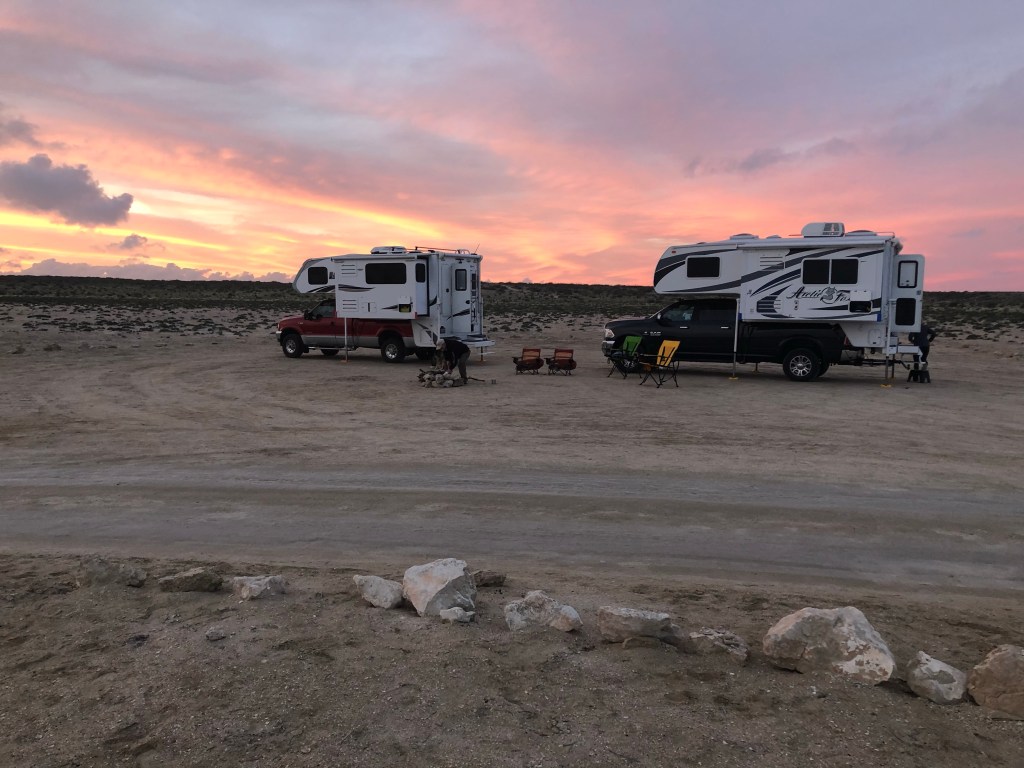
We reach the end of the road, turning around at a “whale safari” tent camp that does not appear affiliated with the original establishment that we paid at the entrance station. We select a site, level and large enough to accommodate both trucks. Across the dirt road separating our campsite from the water, an osprey sits proudly perched on a road sign a scant 3 feet off the ground, holding a partly-devoured, bloody fish in its talons. One of JD’s favorite birds. A good omen. After setting up camp, we take turns scouting whales surfacing out in the waters before us. Before we settle in for the night, we take a walk out to the shore at sunset for a closer look at the whales. In addition to several spouts off in the distance, we see several whales “spy hopping” – a term used to describe when whales orient themselves vertical in the water column, and raise their head several feet out of the water, like a telescope emerging from a submarine from below the depths. As the evening light gives way to total darkness, we turn back to head for camp, we hear a band of coyotes striking up a chorus of howls in the hills above our campsite.
Overnight, a light drizzle of rain and some fairly strong winds has brought cooler temperatures. We wake to clouds and a light drizzle. JD offers the idea of using today as a travel day, heading toward Mulegé, and possibly on to Loreto, then returning back here en route to Bufeo when the temperatures warm. We emerge from our camper to float the suggestion by Lee and Kathy, and find them already up, sitting in their camp chairs, scouting whales through their binoculars. They report seeing dozens of spy hops, and multiple dozen spouts – a virtual whale playground out on the water. However, acknowledging the chill in the air, they are flexible and willing to return in a few days, hoping for warmer weather. We slowly pack camp, and prepare to leave, taking note of several pongas heading out from the dock. Whales continue surfacing, spy hopping, even breaching out in the lagoon. We take turns shutting off our trucks to sit quietly and watch them through binoculars. It’s clear that none of us wants to leave.
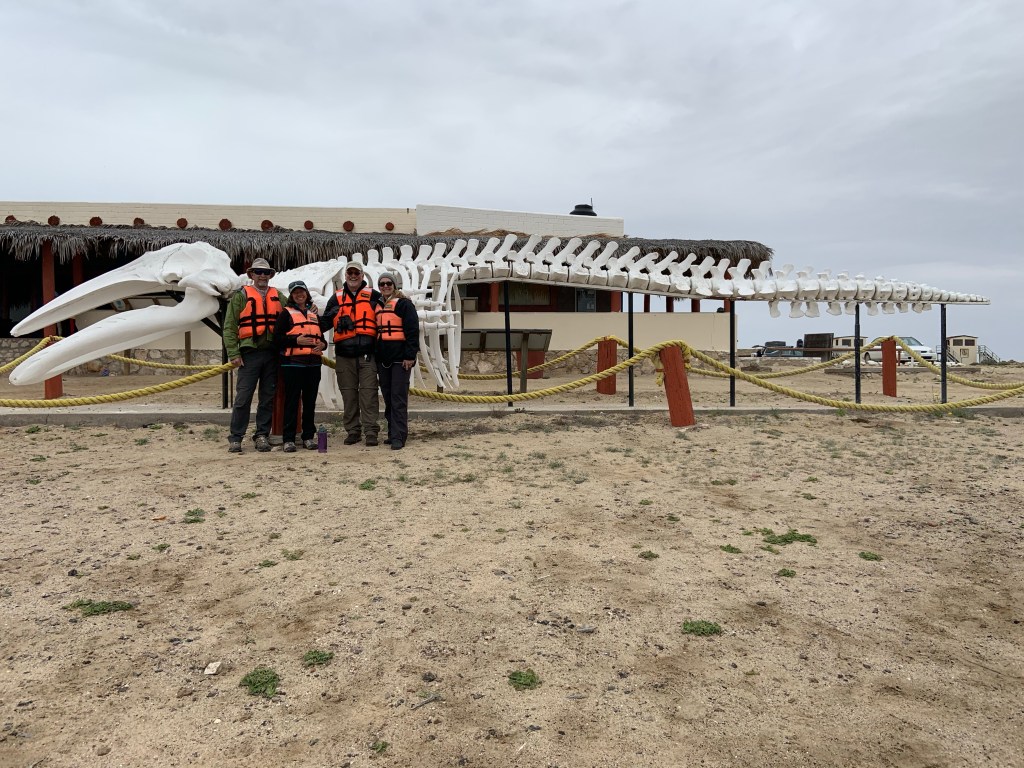
As we drive toward the exit, JD and I decide to stop at the front guard station, to inform our decision about whether to stay or go. We park, and walk into the adobe building serving as the guide station, ticket booth and restaurant. Upon approaching the ticket booth, we learn that for $50 each, we can go for a 2-hour tour, leaving in approximately 30 minutes. We decide to go for it, paying our fee, then heading back to the campers to don extra layers of clothing for the cool boat ride.
Walking the pier out to the docked pongas, Kathy, who is prone to seasickness, jokingly says she feels like she is walking the plank. We laugh as we approach the boats behind a Mexican family of 6, including a little girl perhaps 5 years old, adorned with a pink bow in her jet black wavy hair, which perfectly matches her pink life vest. She is talking rapidly to her parents and siblings, obviously excited about the adventure she is about to have.
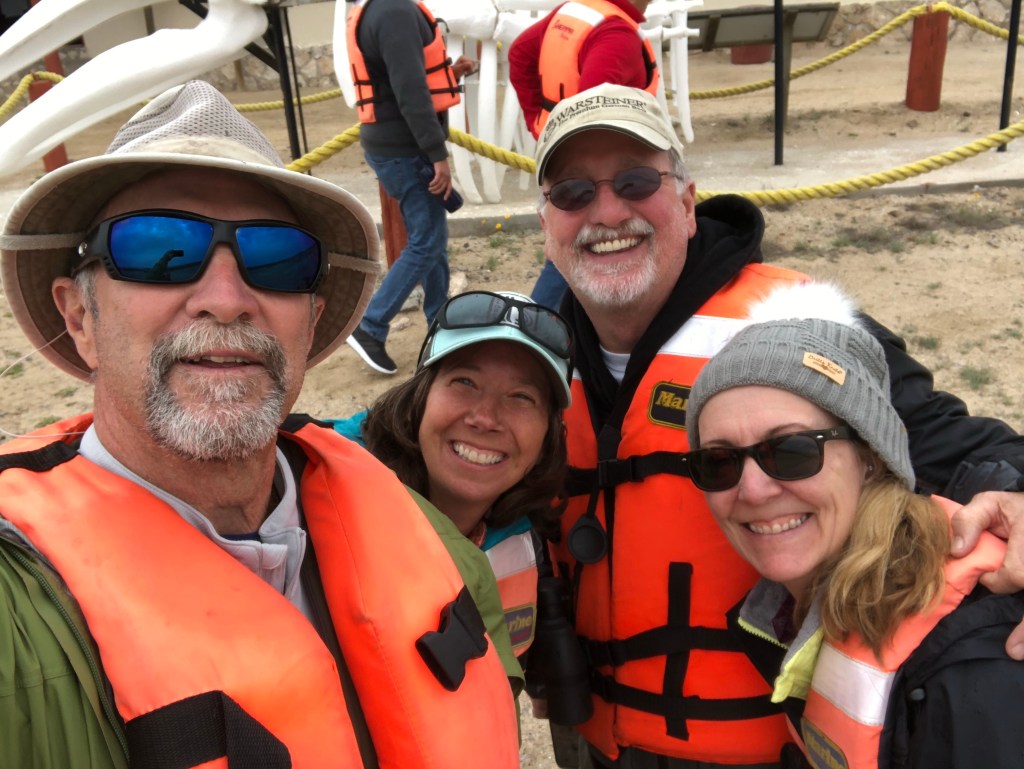
We find Captain Raul, who welcomes us aboard his sparkling clean ponga. He is maybe 25 years old, and speaks no English. Lee, Kathy, JD and I are joined by two Mexican women aboard Captain Raul’s boat. As we get underway leaving the dock, one of the two women enthusiastically begins to make conversation with us, asking first if we speak Spanish. JD motions to me, saying I do, and I clarify “un poco” (some). She gives me a big smile, and says she speaks “a little” English, so we should be fine. We all laugh, and begin to tell one another where we are from – Lee and Kathy are from Indiana, JD and I from Montana. I ask her “de donde viene?” She is from Guerro Negro, the nearby village.
The excitement in our boat is palpable as we get out into the bay. It isn’t long before we see a whale spout, then another, paired off, 100s of yards in the distance. Before long I have counted at least six different pairs of spouts within view. With my naked eye I can see that the two pongas that left the dock with us, which are traveling together because they contain a large school group, have a pair of whales between them. I point this out to the others in my boat, and conversation slows, as we look longingly. Captain Raul sees this, but continues his course, clearly intent on where he is going, away from the other pongas. After a few minutes, he slows the throttle, signaling that we are getting close.
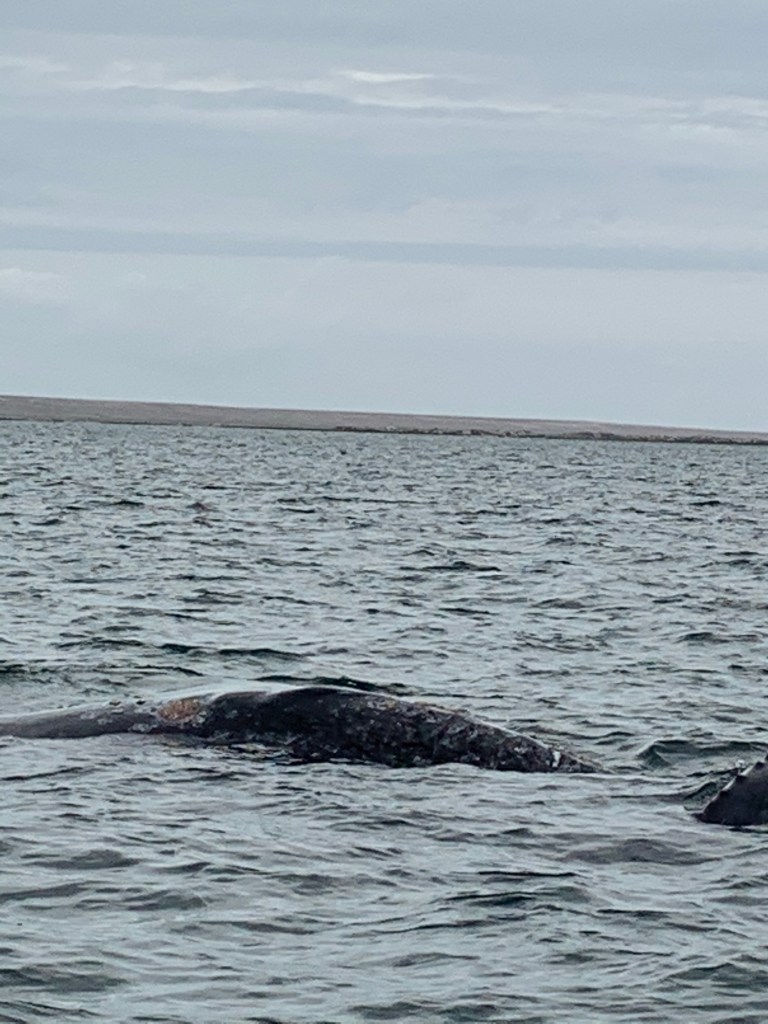
It isn’t long before a mother cow and her calf surface nearby, much closer this time, between 10-20 feet off of our starboard side, moving slowly toward the stern. The first indication we have of their presence is the mother’s head suddenly rising out of the water, and the near simultaneous sound of her forceful exhale, through a pair of nostrils (“blowholes”) located just back from her snout, sending a spray of water (and other fluid I’d rather not think about!) into the air, and onto several of us. Her calf, perhaps a third her size, emerges just after, on the far side of its mother, further from our boat. They inhale, and make a shallow dive beneath the back of our boat, disappearing again into the sea. Even our Captain was caught off guard: he looks at us, smiling, hand to his chest, revealing his surprise, and his delight. He has found them. Or, perhaps it is more accurate to say that they have found us.
We collect ourselves, somewhat, amidst excited laughter and rapid banter. We still can hardly believe what we have just seen. Captain Raul, now confident they are here, reaches over the side of the ponga, dropping his hand in the water and splashing it around at the surface.
Kathy touched one first.
The young calf, seemingly lured by the Captain’s splashing, surfaces parallel to the ponga on our port side. Kathy, who has remained seated thus far in an effort to ward off motion sickness, calmly reaches over the side, her fingertips gracing the calf’s back for a few miraculous seconds, before it again descends below the surface, out of sight.
I touched one next, scrambling to the port side of the boat along with the Mexican woman, native of Guerro Negro, who had brought her friend with her to see the whales for the very first time. The young calf again emerges alongside of the ponga, this time coming from stern to bow, emerging and exhaling just as it got close enough to touch. I looked down directly into it’s pair of blow holes, as I reached down to caress it’s head. It’s skin was soft, dense blubber, giving way to the pressure of my touch. I was spellbound.
As I returned to sit beside JD, who had been filming and working to counterbalance the boat by placing his weight on the starboard side, he asked me – did you get to touch it? I said enthusiastically, yes! He smiled. Then he said, longingly: “I want to touch one so much I can’t stand it…” I could see, and feel, his yearning. I want it for him, too.
The mother and calf remained nearby for some time more, the young calf teasing us with its curiosity, and would approach the boat, then dive just deep enough to still be seen beneath the waters surface, yet well out of our reach. JD and I joined the Captain in splashing our fingers in the water’s surface, hoping to attract their attention.
And then, suddenly yet as if on cue, the mom emerged off of our bow, heading again toward the port side of the boat. JD scrambled over to the port side, with focused intent. I instinctively grabbed the back of his life jacket as he leaned over the side toward the water; it appeared for a moment that the whale might be just out of reach, but I encouraged him to lean further still. He did, as the mom raised itself still further out of the water, allowing JD to make contact. His hand caressed its spine for some 3-4 feet of its length before she dove again, out of sight. JD sat back into the boat, awestruck. I hugged his neck, sensing his emotion. I could see him choking back tears. We looked up as Lee asked him “how was it?” to which JD responded simply, “wow.” Lee caught the entire encounter on video, memorialized forever.
As JD moves back to his seat next to me in the boat, our group sat in reverent silence for several minutes, looking out onto the water, which for the moment, was also quiet.
Then, some 100 feet off of our bow, the calf emerged again, this time remaining at the surface with its mouth 3/4 of the way above the water, I assume so that it’s eyes were positioned above the water, making it possible to get a clearer look at us. The mother whale wasn’t visible initially, but then surfaced behind the calf, seemingly lifting it up and helping it to remain buoyant with her mouth. After several minutes, the mother whale became totally still, she too suspended, floating at the surface of the water. We hear the Captain tell the Mexican women that the mother whale is “sleeping”. JD and I had read about this pattern just the night before; although it isn’t thought that whales actually sleep, they are known to rest for periods of time, just as this one was doing now. Meanwhile, her young calf seemed more active than ever, surfacing and diving around his mother’s mouth, repeatedly bumping into her. One of the Mexican women, the more talkative of the two, laughingly says to no one in particular, in halting English: “baby says ‘Mama mama, wake up, no sleep, play!” I nod, responding, “es la verdad por todos las animales!” She agrees.
As we continue watching this display, one of the other pongas approaches, circling around behind the mother and calf pair. I hear a young child saying repeatedly “Hola, hola, hola, hola!” I look closer and see the little Mexican girl from the boardwalk, with matching pink hair bows and life jacket, waving enthusiastically at the whales. Both of our boats sat quietly watching for a few minutes more, until Captain Raul motioned to the other ponga, instructing them to move away. They did, slowly, and headed in the direction of the dock. Our boat remained some 30 minutes more, until the waters again grew quiet, and judging by the distance of the nearest spouts, it appeared the mother and her calf were slowly moving away.
Once again I took notice of how quiet our boat and it’s occupants were, sitting perfectly still reflecting on what we had just experienced. I quietly took stock of my own emotions: I was so thankful for the experience, not yet ready for it to end, hoping for one more glimpse of those magnificent gray whales. Then, after a moment, it was clear that was not to be, and I turned back to face our Captain, placing my hands together at my chest, palms touching, and bowed my head in thanks. He smiled and nodded in appreciation and deep understanding, then apologized humbly before starting the motor, and turning the boat toward home. I turned to face the bow, and as I sat quietly looking out on the water, I felt my yearning give way to contentment, my heart full with gratitude, a feeling of having enough. And over the rest of the boat ride home, I considered how life, and love, is like that: excitement at the anticipation and then the novelty of the encounter, the thrill of shared experience, yearning for more, holding on not wanting to let go, followed by a slow acceptance that eventually, we must.
These gray whales were curious enough to spend two hours in our midst, when some hundred years ago, our species was hunting theirs to extinction. The preserve at Ojo de Liebre was established in 1972, the year I was born, the first of its kind anywhere in the world. And now, the lagoon waters that used to run red with the blood of mass slaughter form a place of refuge for them and for us, a place where we humans can be graced and reminded, if we are lucky enough, by these mysterious, beautiful, humble, resilient creatures of the sea.




Great update on your adventure. Keep them coming.
LikeLike