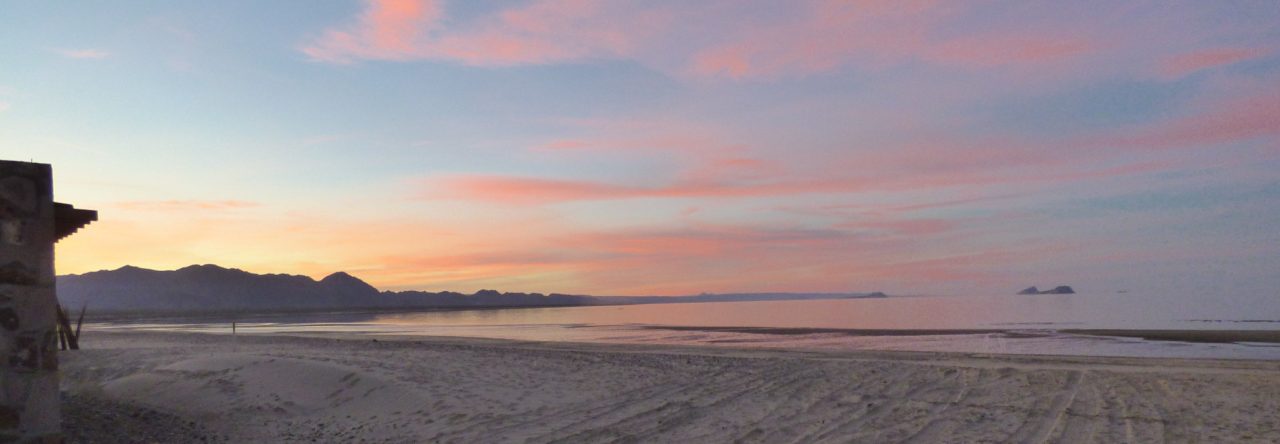
The road to Brandberg National Heritage Site contains several Himba and Herero villages. Although we had seen bare-chested Himba women in town at the craft market in Swakopmund, seeing them in these conditions was different.
Each roadside village consisted of a variable number (I didn’t count, but between 6-10) of huts arranged in a circle, constructed out of wood and mud. Some villages had goats and chickens, some didn’t. All were occupied by women and children, and young girls who were mothers themselves. Sometimes young men were present, sometimes not. The children, some naked, some wearing shirts too small or too big, walked about, without pants. Many, seemingly as young as 4 or 5 years old, carried toddlers on their hips and backs.
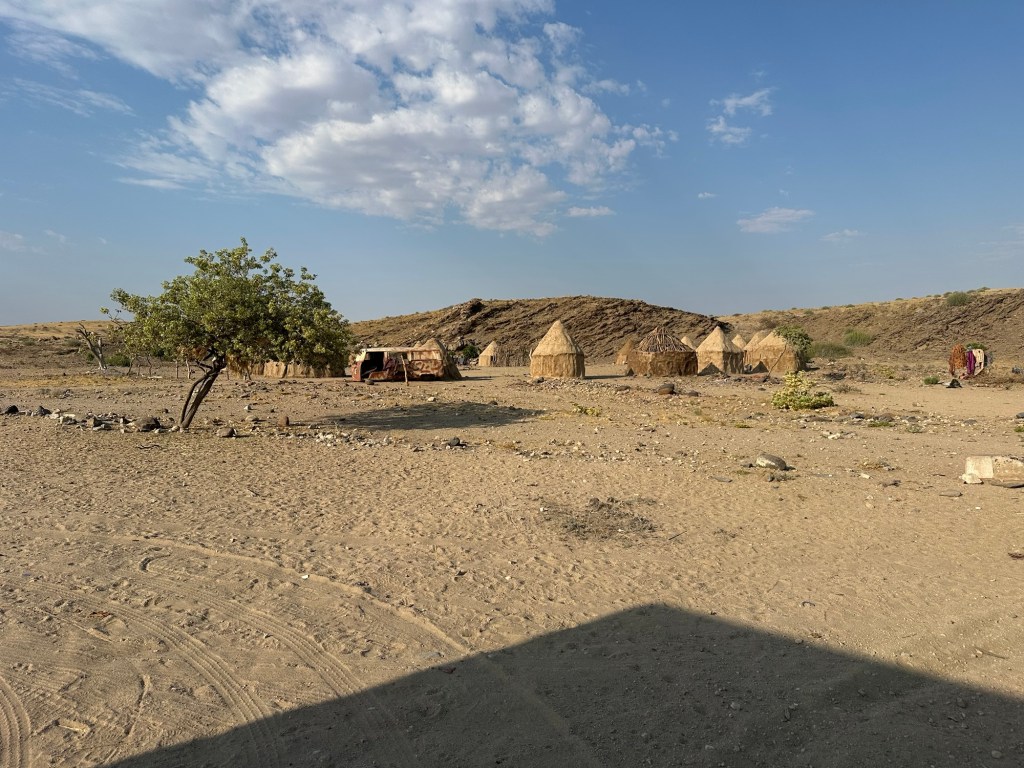
Each time our bus approached a village, one of the women – a sentinel of sorts – would walk out to the road, making herself plainly visible and often calling out. If our bus didn’t slow down, these women quickly turned their backs, returning to their huts with what appeared to be resignation, maybe disgust, often both.
Some of the villages had crafts for sale, positioned to catch our attention as we drove past. For JD and me, the similarities with Native Americans, peddling wares on the side of the road across the desert southwest of the United States, were inescapable. As were the uncomfortable disparities between the lives of these villagers, and those of us aboard our bus, regardless of gender, skin color, ancestry or citizenship.
We passed these villages on the way to and from our Brandberg Mountain hike, and again the following day as we left for Etosha National Park. Reactions to, and opinions about, the conditions we observed varied widely among our group of travelers.
After a flurry of debate, we stopped at one of the villages on the way to our hike. Some of us got out, offering our snacks and water to the women and children – most of whom eyed us with a mixture of what looked like curiosity, skepticism, and cautious gratitude. One of the Himba women spoke more English than the rest, translating what couldn’t be conveyed in facial expressions and gestures.
A small Himba child, more playful and energetic than the others, danced at his mother’s side. A few of us joined him. The Himba women observed, slightly amused. Meanwhile, one member of our group ventured further into the village with her husband, conversing with some of the Himba women while taking pictures of and with them, showing them the pictures as she did so.
As we returned to our accommodations for the night, this woman announced her resolve to buy some food for the villagers. A group of us agreed to contribute, walking to the only market in town, a gas station, just as it was closing for the day. We bought what water, sugar, tea, peanut butter, maíz and loaves of bread they had. JD, who had not gone on the hike, showed up to see what was happening. Listening to our impassioned descriptions of the living conditions we had seen, he helped us carry our purchases back to the bus.
The next morning, we passed through these villages again en route to Etosha. JD and I exchanged silent glances as he began to take in what some of us had seen the day before. He felt our concern. We stopped at the first village; a lone woman emerged and began walking towards us. Some of us emerged from the bus with water, bread, bags of sugar, and loaves of bread. She, and the other women who had come out to join her at the road, accepted them with humble gratitude. Some members of our group began taking pictures. JD and I hung back, uncertain and conflicted. Something felt off. In our efforts to do some good, were we somehow keeping these people stuck, subsidizing them as a tourist attraction?
As we approached the second village, JD and I decided to get out and engage more with the villagers. We collected our offerings and walked over. As before, their gratitude was unmistakable, as were their silent attempts to figure out what other intentions our group might have had.
After a few minutes of halting exchanges, we felt a return of self-consciousness, and stepped back. We considered returning to the truck. Just then, one of our fellow travelers, a young Norwegian woman named Live (pronounced “ Lee-ve”) who lived in Africa with her journalist parents as a child, walked past us and silently knelt in the dirt before a small Himba child.
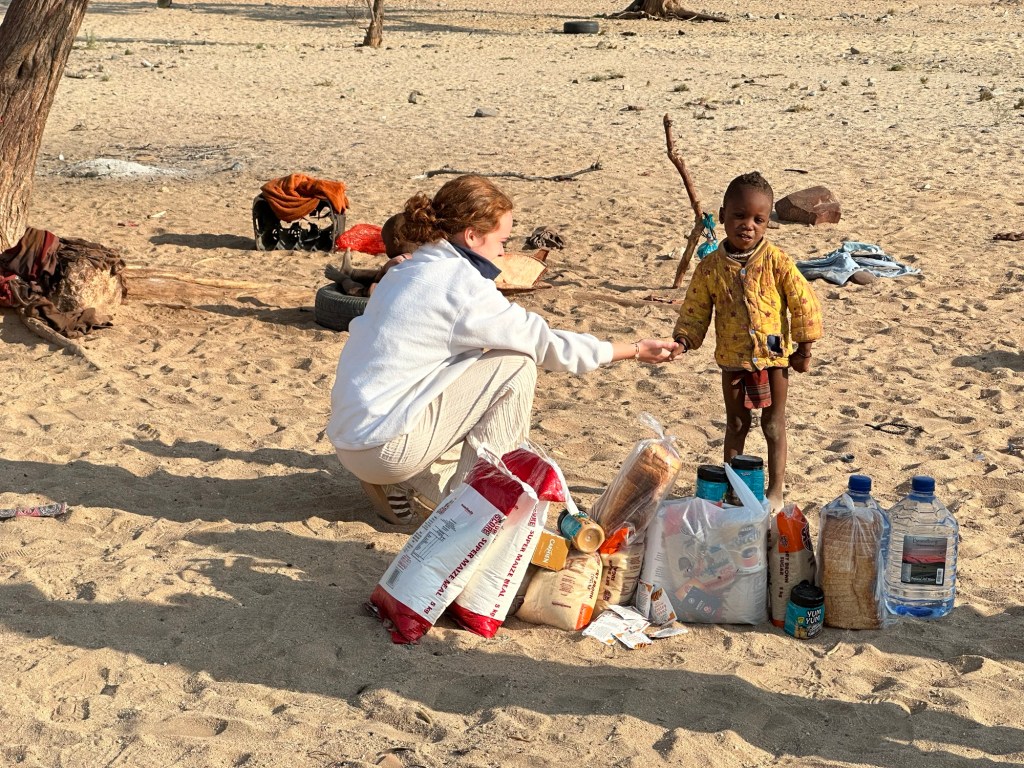
Live gently extended her hand, and the child took it. They sat there, silently looking at one another holding hands, for many minutes. And with her simple gesture, Live reminded us that there is one thing we can always offer that is rarely, if ever, wrong: compassionate presence.

 If You’re Lucky Enough: Carolyn and JD’s blog
this has to have been hard. I remember the poor in India…the hopelessness of it all.
LikeLiked by 1 person
Yes, it was hard. And, evoked a lot of questions – without simple answers – about how much is really required for happiness. Thanks for reading, Liz.
LikeLike
Thank you for sharing your thoughts and emotions Carolyn, you have a gift putting what you are experiencing in words.
compassion speaks volumes
LikeLiked by 1 person