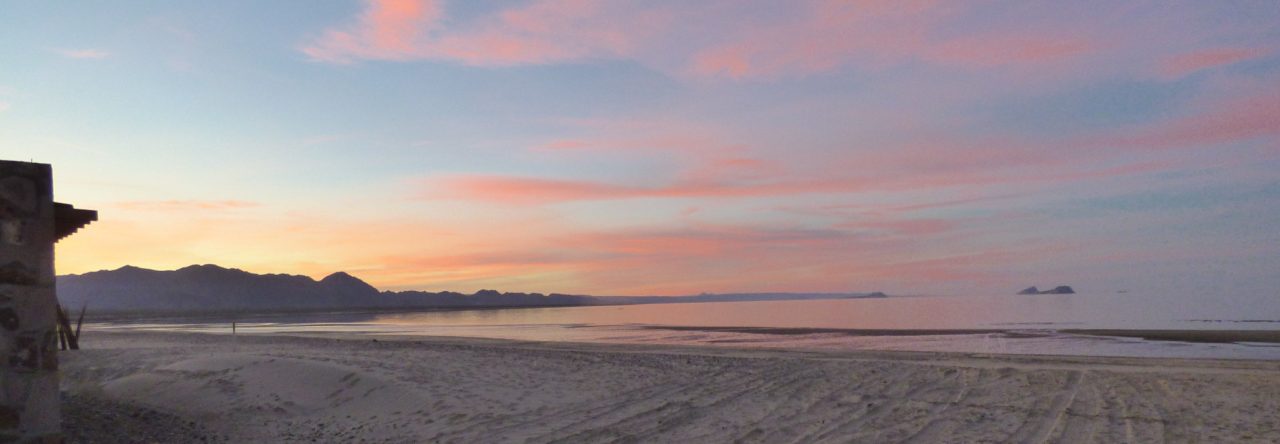
Ross, Jane, JD and I met our group’s primary guide, Goodness, in the lobby of the Double Tree Hilton in Cape Town’s Upper Eastside. She verified our passports and e-visa applications for our upcoming crossing into Namibia, and answered our many questions. I loved her kind, assertive enthusiasm immediately.
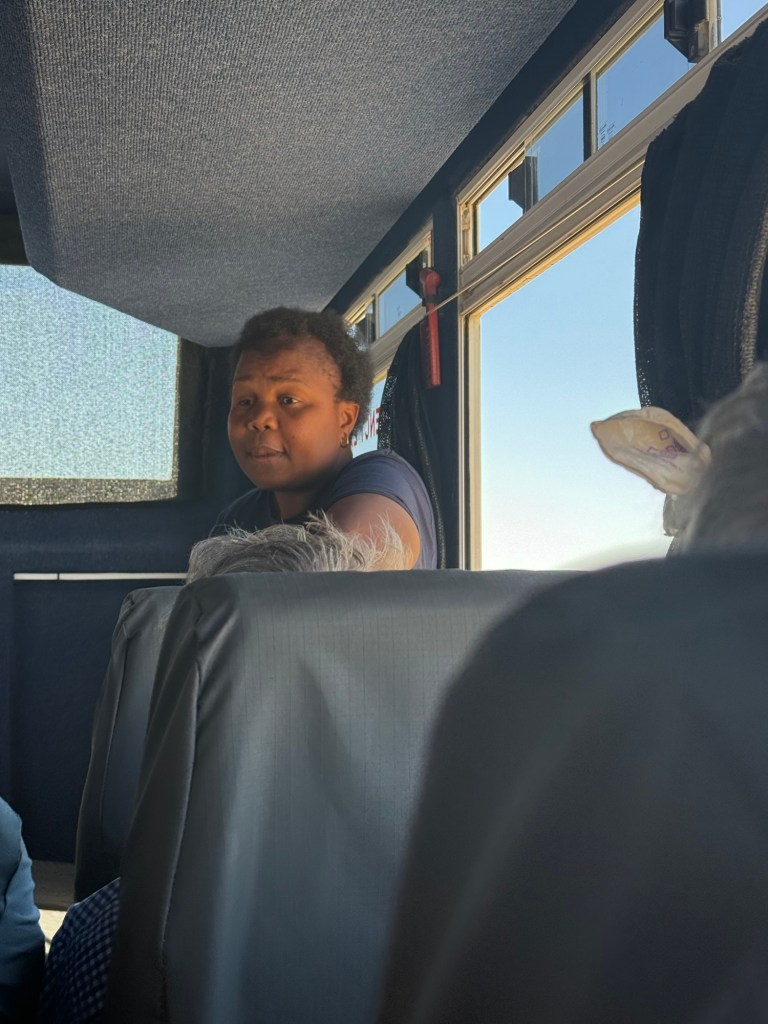
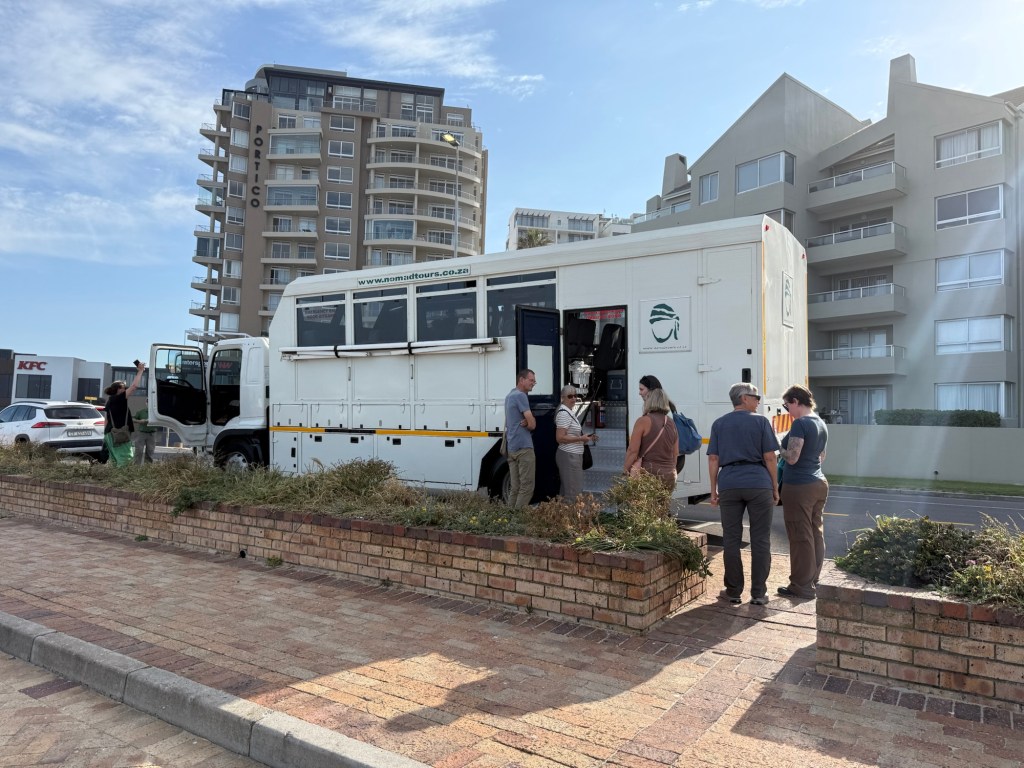
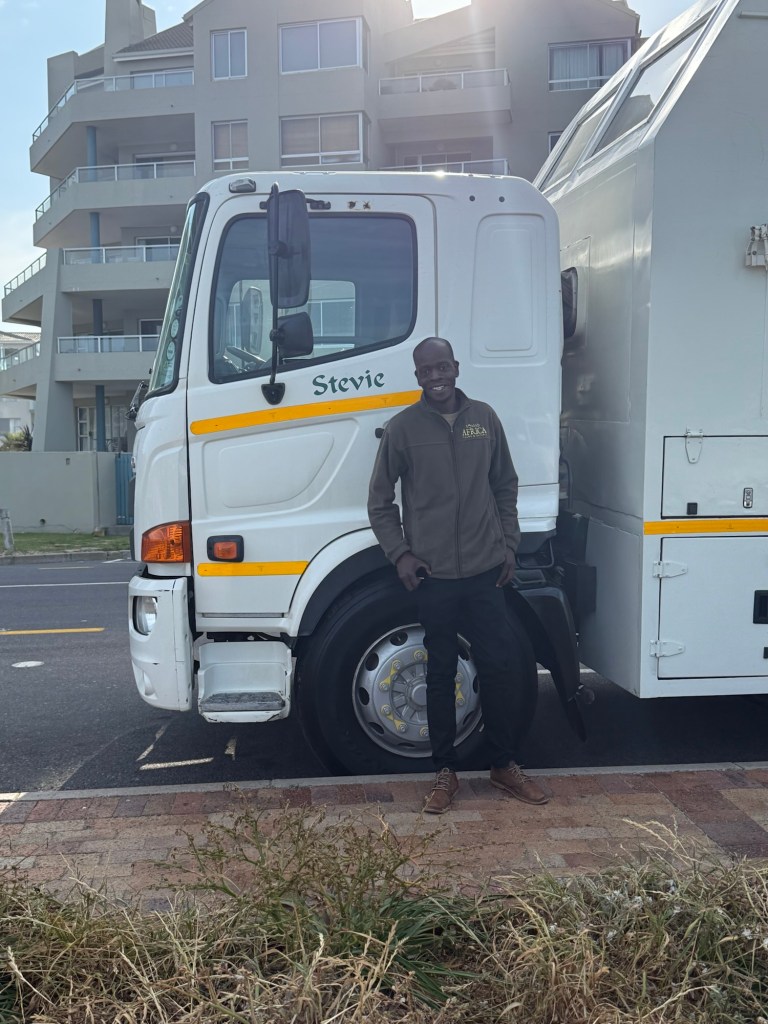
Goodness instructed our group of 20 passengers to meet her and our driver, Victor, the following morning outside of our hotel. We began to board “Stevie”, Nomad’s 27-passenger overland vehicle custom outfitted with coolers, lockers, and USB-ports for charging electronics. Victor told us that Nomad’s fleet of 38 trucks are all named after dead musicians- so we guess ours is named after Stevie Wonder. As we pulled out of the parking lot, Goodness’ taught us our first Zulu word: “Asambe!” – meaning “Let’s Go!”
Driving north of Cape Town along the coast, we stopped to look back at Table Mountain from Table Point. Still well within the larger metropolitan limits, I paused to admire their extensive dune revegetation efforts, complete with irrigation, signs and drift fencing.
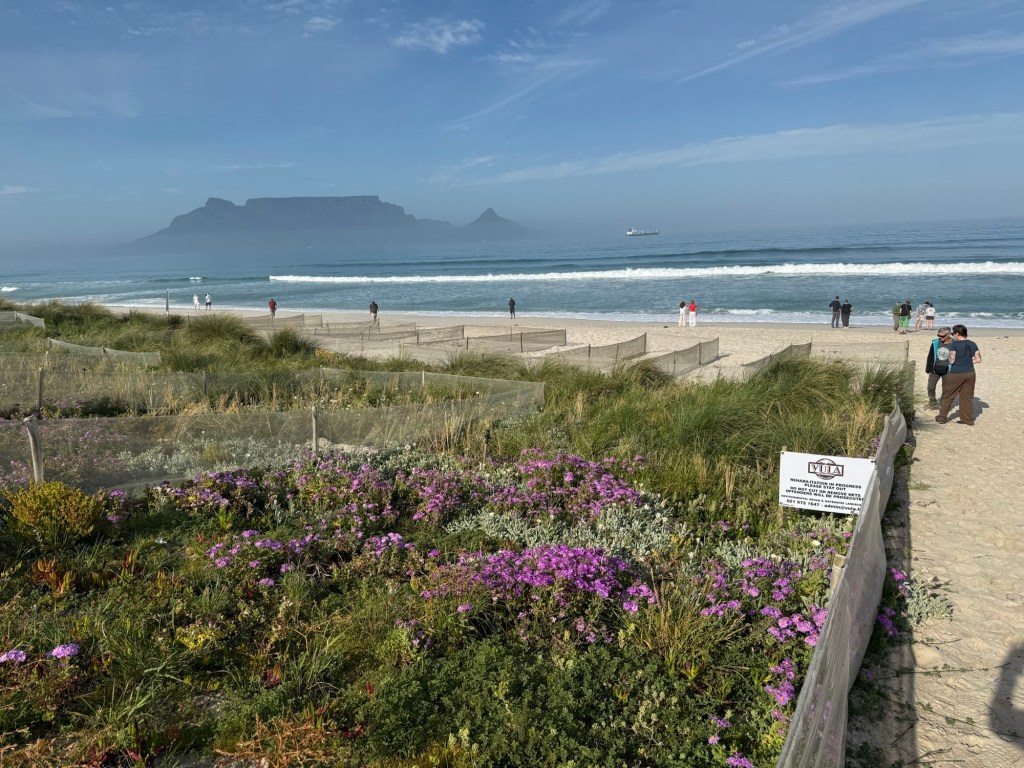
from Table Point
We stopped for wine and rooibos tea tasting, where I bought some rooibos tea (citrus chai), and JD bought a bottle of wine. As we left the winery, a delightful smell of citrus began to fill the air of our vehicle. On both sides of the highway, throughout the valley, were fields and fields of citrus trees – oranges, lemons, tangerines. Also, apricots. I wish I could bottle that smell. An hour or so later, we turned off of the pavement, arriving at our first night’s lodging at a 5th generation, family owned citrus and rooibos tea farm and guest house. The property owners and hosts graciously served our group of 22 a dinner of chicken, vegetables, and potatoes with custard for dessert.
As we drove further north towards Namibia, the landscape became progressively drier and rockier, reminding JD and me of Baja California in terms of geology and vegetation.
We woke the next morning (the 28th) and departed by 7am, headed for the Namibian border. There, we waited in line first for agricultural inspection, which included having our shoes treated to prevent the spread of hoof-and-mouth disease. Afterwards, we presented our passports and visa applications to friendly, welcoming border agents. Between exiting South Africa, and entering Namibia, the border crossing took about two hours.
We arrived at that night’s accommodation – Felix Unite Cabanas – just past dark. Our guides served us a delicious dinner of chicken and saffron rice, lentils, and salad, before we all eagerly retreated to bed. JD and I awoke at sunrise, our cabana on the Orange River perfectly oriented east to greet the day.

After breakfast, I opted to go canoeing on the Orange River, which forms the border between South Africa and Namibia. Our group’s guide was Salom – a name that means peace, in many languages. I sat as Salom’s rock spotter, in the front of his 2-person canoe, as our group of 12 people, and six boats paddled downstream. Over the next two hours, soft-spoken Salom serenely pointed out gray herons, cormorants, African (?), purple morning-glories, reeds, ducks and the occasional fish. We came to a spot along the river that Salom identified as a point of illegal border crossing. When I asked which way people tended to be crossing, he told me they were going to South Africa, for work. I told him about a similar pattern at the American border with Mexico.
I asked Salom if he liked to travel; he said yes, that other than his native home of Namibia, he has visited South Africa, and Zimbabwe. He wants to go to Angola, but hears that it is dangerous, corrupt. He asked if we have these problems in America. I said in some places, yes.
Perhaps three different times during our two-hour paddle, we encountered adults fishing, sometimes with young children, and an occasional dog. Some had boats, others were wading in the water with a fishing line in their bare hands, no rod, just a hook. Salom exchanged cheerful greetings with them all, and they waved back to us.
We returned to camp about two hours later, and after a quick lunch of spaghetti, salad ad tunafish. said our fateful goodbyes to Salom and his assistant guide Jaelyn, bound for the Fish River Canyon that afternoon.
The drive to Fish River Canyon took about three hours. Located in a National Park, the Fish River Canyon is frequently described as second only to the Grand Canyon in terms of size. Even before approaching the rim and peering down into the depths, the parallels were striking: broad, flat-topped mesas as well as tall, narrow, monuments and temples, emerging from distinct layers of sediment and rock spanning 1.5 million years of geologic time.
We walked a trail along the rim for an hour, noting informal labyrinths that someone had created along the way, as well as occasional bursts of color from wildflowers and quiver trees, a type of aloe plant.
The evening of Monday, the 29th we arrived late in the town of Ketmanshoop. One of our fellow passengers, Corren, graciously swapped rooms with JD and me, giving us a double bed. Amazingly modern, well-appointed rooms.
We woke the morning of Tuesday the 30th to a quick breakfast and a stop to explore the Quiver Tree Forest, a privately owned protected area. One of the most characteristic plants of hot, dry, Namibia. It’s an aloe, called the quiver tree because bushmen used the tough, pliable bark and branches to make quivers for their arrows. 90 meters high, a meter in diameter. Bright yellow flowers appear in the winter, June and July, when trees are between 20-30 years old.
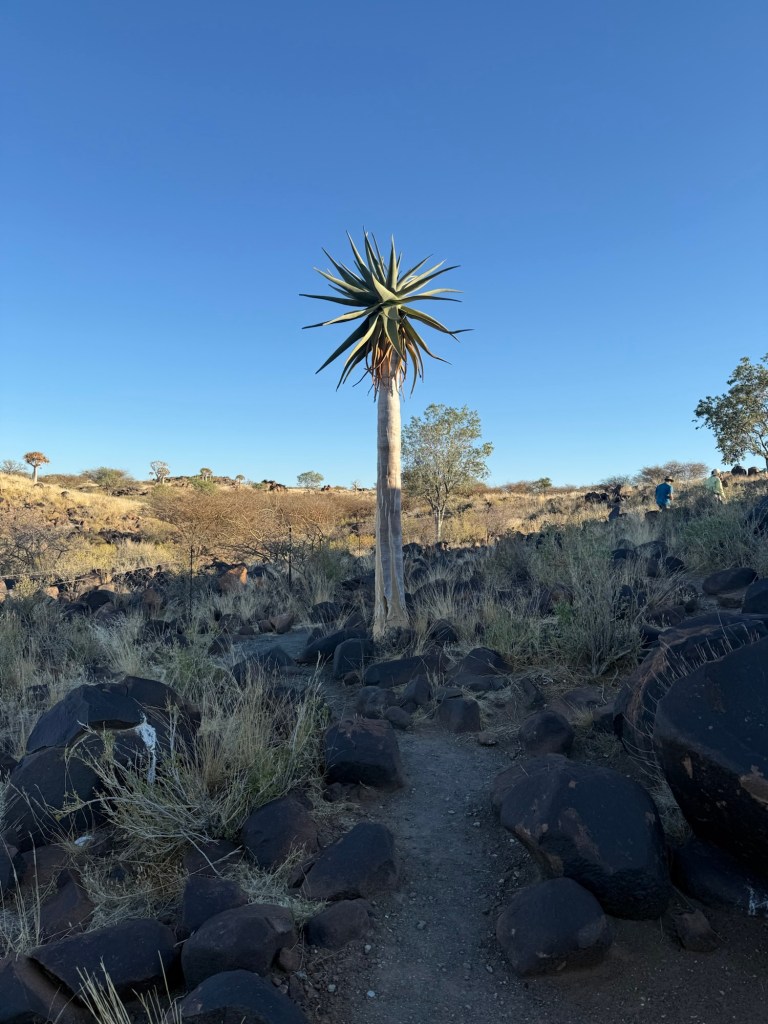
Our next stop was boulder-hopping around the Giants Playground, dolerite boulders medium-grained, dark gray boulder-ish rock, covered with desert varnish, with similar composition as basalt. Formed 180-million years ago.
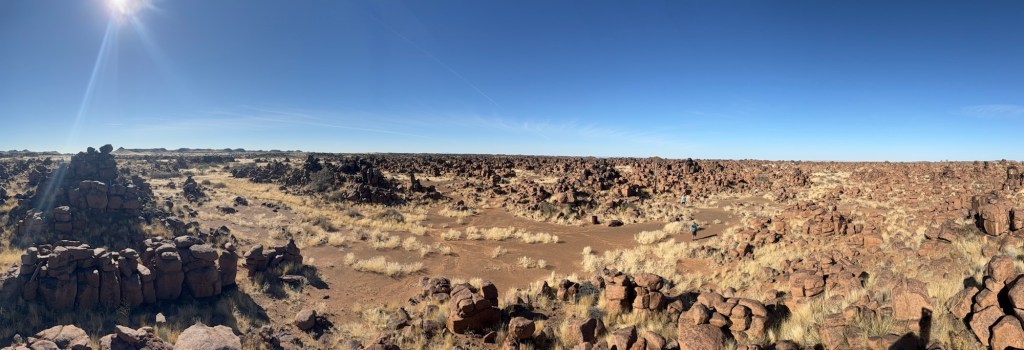
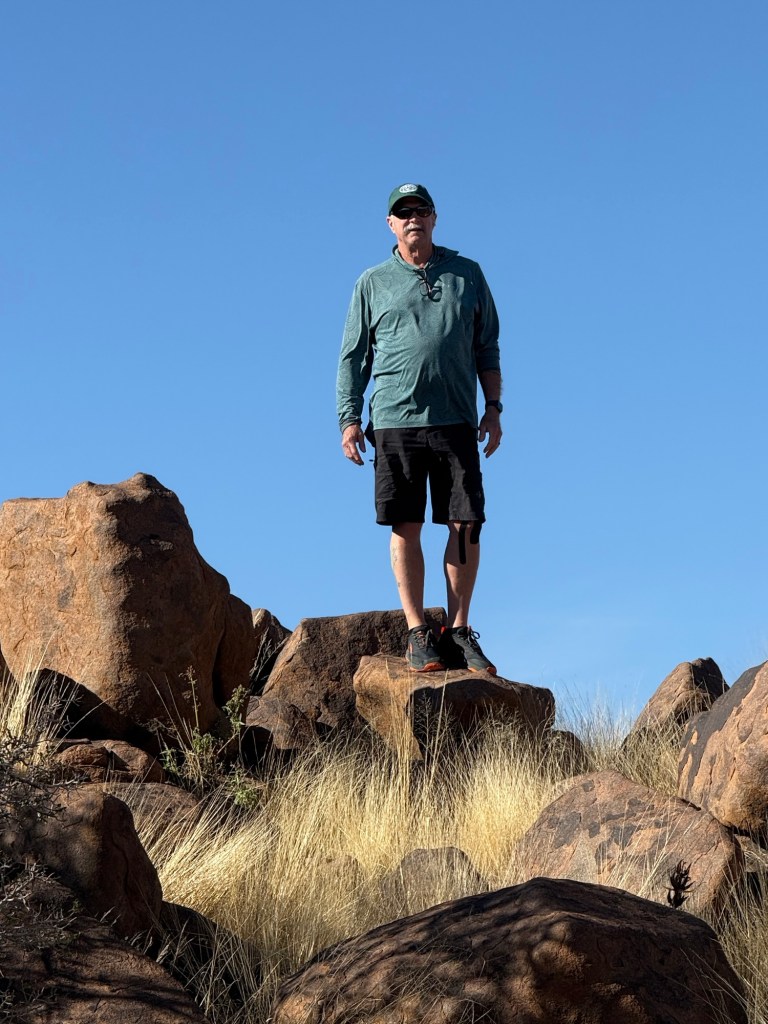
Well, here’s where intentions meet reality: as anticipated, it’s hard to be present with all that we’re seeing and doing, exchange photos with JD and write… so these entries are likely to get a little more choppy! But, you’ll get the gist and it will still help us remember what we did and saw here. We’re without WiFi for the next day or so, so stay tuned!
 If You’re Lucky Enough: Carolyn and JD’s blog