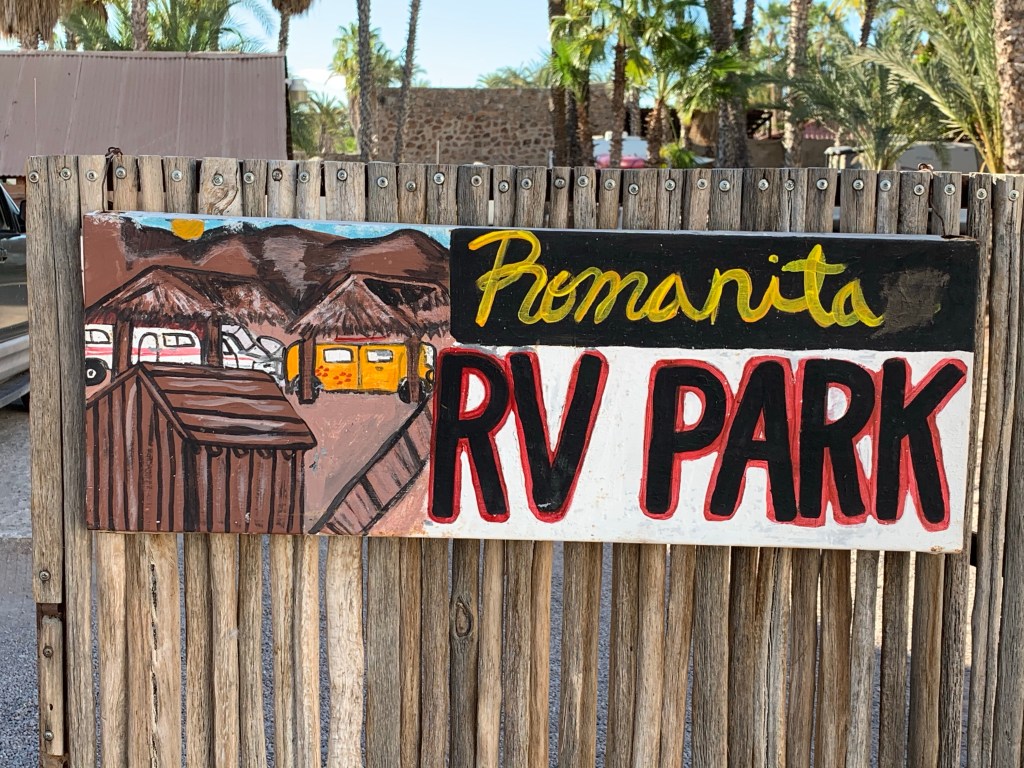
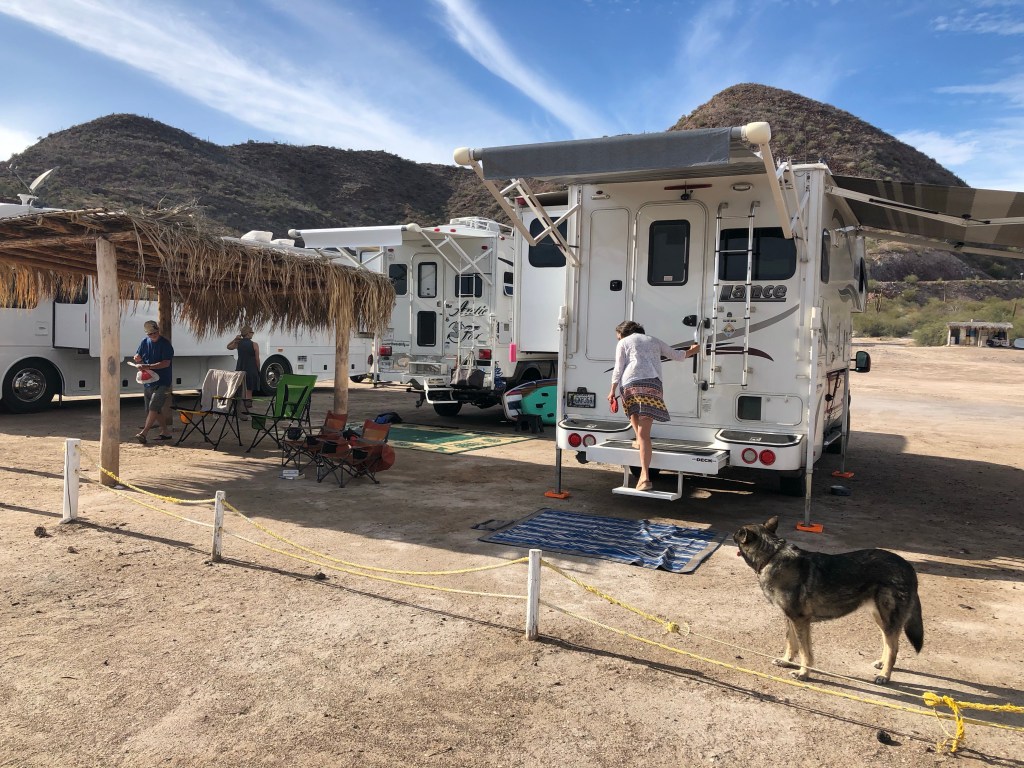
We pull into Loreto, the longest occupied town in all of Baja, and turn on our cell phone navigation, seeking directions to Romanitas, the RV campground recommended by a Canadian couple that we met in Mulegé. As the navigation directs us down a side street, JD suddenly slams on the brakes. An electric wire from a nearby telephone pole is hanging down at eye level as it crosses the road! Had we gone a foot further, we would have easily intercepted it with our truck camper. We make a U-turn and begin reckoning toward the waterfront as we wait for our mapping software to catch up with our diversion. We enter Blvd Salvatierra, an active shopping district that reflects the gringo population here… hair and nail salons, massage shops, upscale art and pottery galleries, Italian wood fired pizza, organic food stores, and marquees advertising “vegan”, “gluten free”, and “organic” foods. As we approach the Malecón, Blvd Salvatierra becomes Avenida Miguel Hidalgo, and the asphalt becomes terra-cotta stamped concrete. We look for Calle Romanita, and find it, signed with no entry to vehicular traffic, just as our Canadian friends advised. We enter anyway, as instructed, and with one more left, we find the signs to the tiny, but perfectly convenient, RV park. We are greeted by the host, Arturro, who tells us he has two sites left. Jockeying our rigs in between palm trees and other vans and campers, we back in and begin to get settled. At $200 pesos a night for water and sewer ($250 with electric), bathrooms with hot showers, and a washing machine, we declare it a bargain.
After a quick lunch at our campers, we head into the plaza to meet friends AJ and Kim, from Reno. Kim works with the US Fish and Wildlife Service, her husband AJ is in construction. After years of exploring the Baja and surfing its pacific coast, they built in Loreto. They are down for a few weeks with their 4 1/2 year old son Kestrel (Kes). Since leaving Reno I have seen precious few of my former friends and colleagues from USFWS, and I’m particularly excited to reunite with them in Baja! As we approach the town Plaza, I hear someone shout out what sounds like my name, and look up to notice a thin gringo wearing a ball cap sitting on a bench beneath a shade tree, looking in my direction. He stands up, smiles, and I realize it’s AJ! I shout to JD, and quicken my pace to embrace AJ in a hug. He introduces me to the older man at his side – Kim’s father! AJ and Kim’s parents are all visiting them in Loreto! We are soon joined by Kim and Kes. I manage to hug Kim in between Kes’s sustained efforts to maintain his mom’s attention, as Kim gives me a short synopsis of things back at the Reno USFWS office. I instantly feel how much I miss the many friends back there.
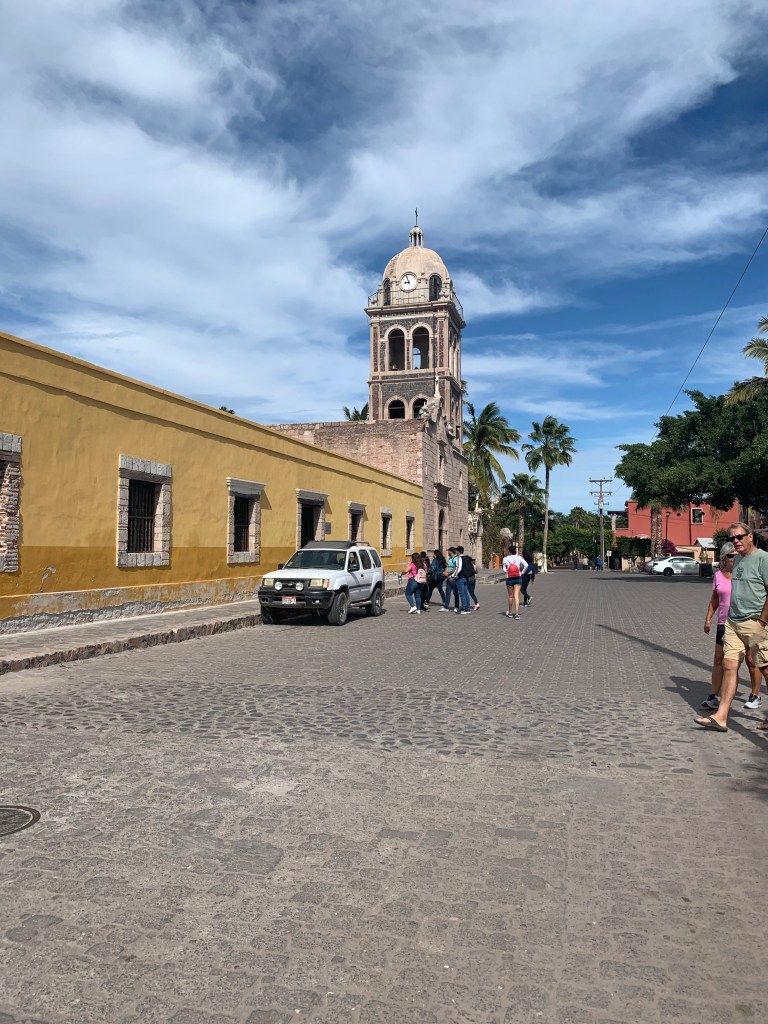
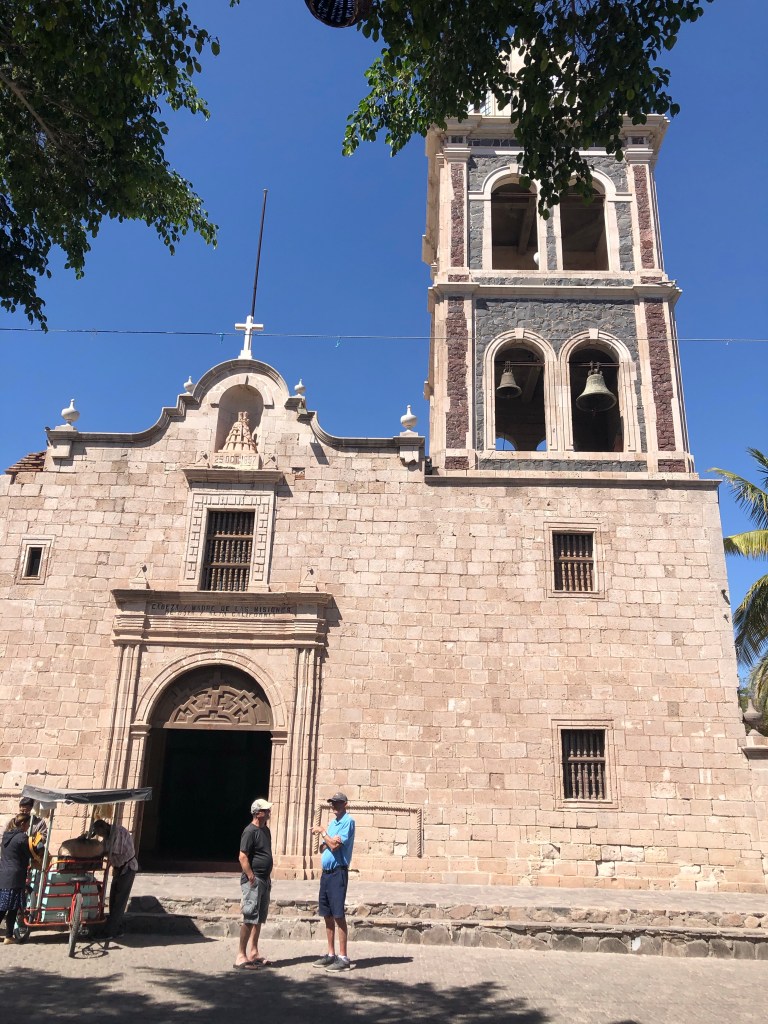
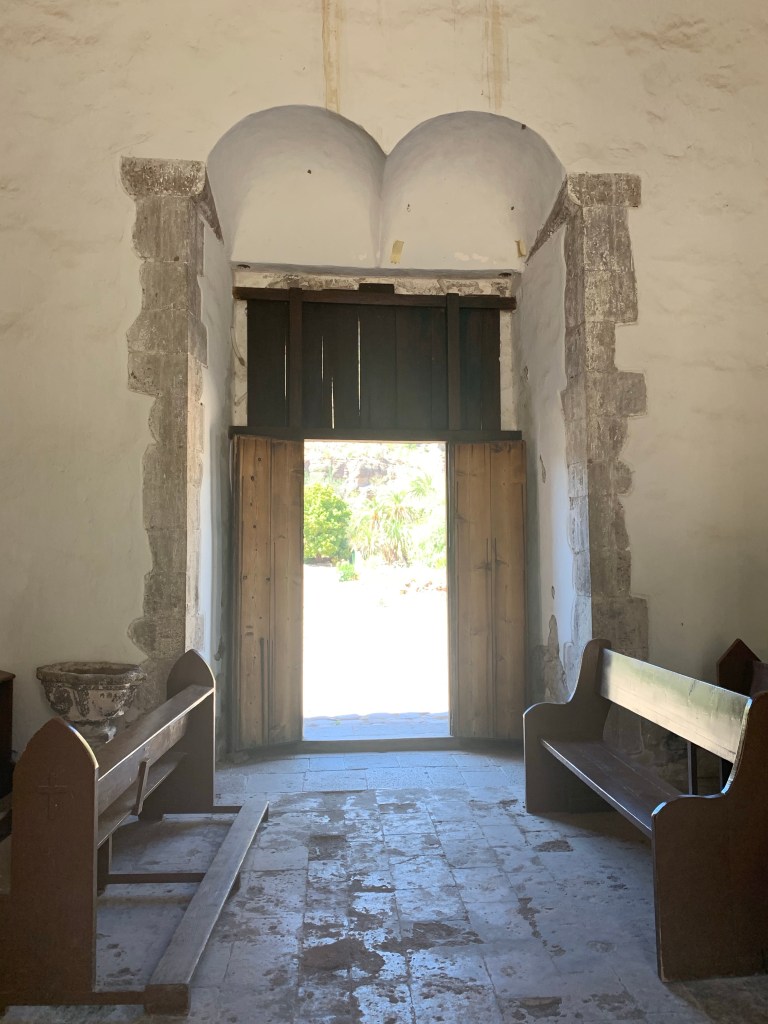
I tell Kim and AJ both that I’m concerned about intruding on their family time, but they insist that we are welcome. So our two groups merge and begin to stroll the streets of the plaza, toward the Misión Nuestra Señora de Loreto. We enter respectfully, removing hats and sunglasses, allowing ourselves to feel the sacredness of this place. I take a moment, kneeling at a pew, and say a prayer. Although I dislike labels, particularly in this arena, I’m more spiritual than religious, but my thoughts on such subjects are evolving. Regardless, I have a deep appreciation for the teachings of love, kindness, compassion and forgiveness epitomized by figures like Jesus, as well as the sacred spaces devoted to such teachings, despite how they have been corrupted by organized religion(s).
I walk quietly back out the front entrance of the Misión, retrieving our dog Pelli from JD so that he can enter. He does, while Kim and I stand continue talking and catching up on the past year. As JD returns, a group of approximately 20 people, Mexicans and gringos, assemble across the street from the Misión’s entrance. They form a circle, and begin to pray. What begins as a quiet, humble gathering quickly turns into a loud, emotional raucous, with the group’s members clutching at their rosary beads, chanting loudly in Spanish, eyes closed, arms in the air, feet pounding the pavement. Finding it hard to talk over their voices, we move away.
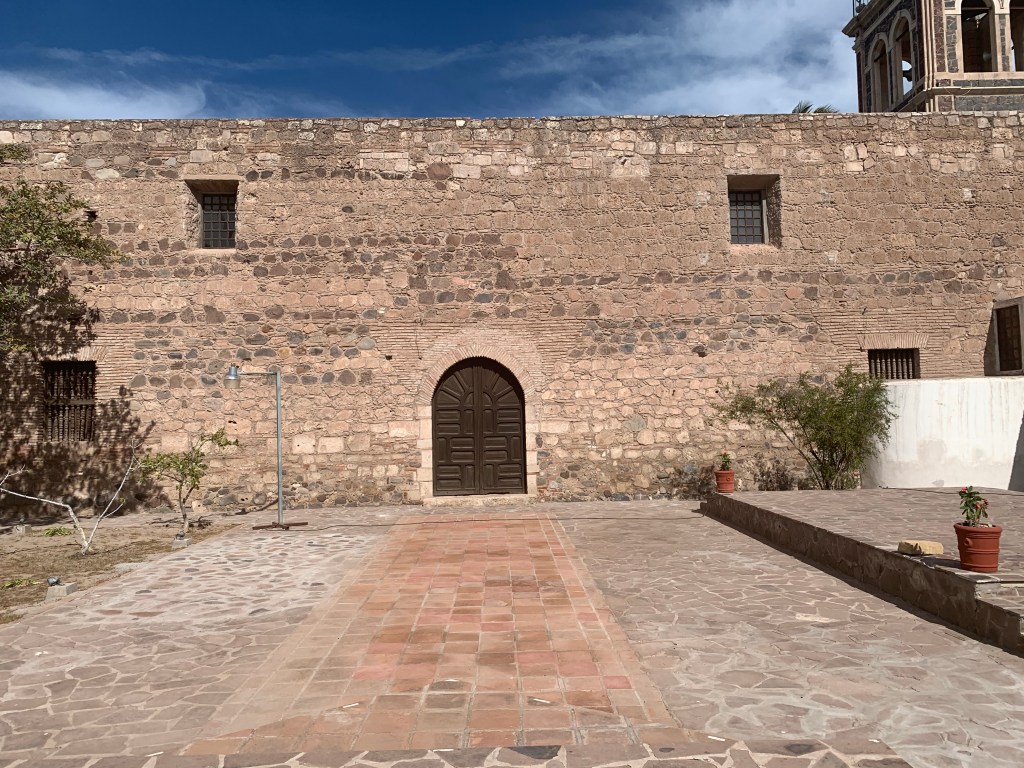
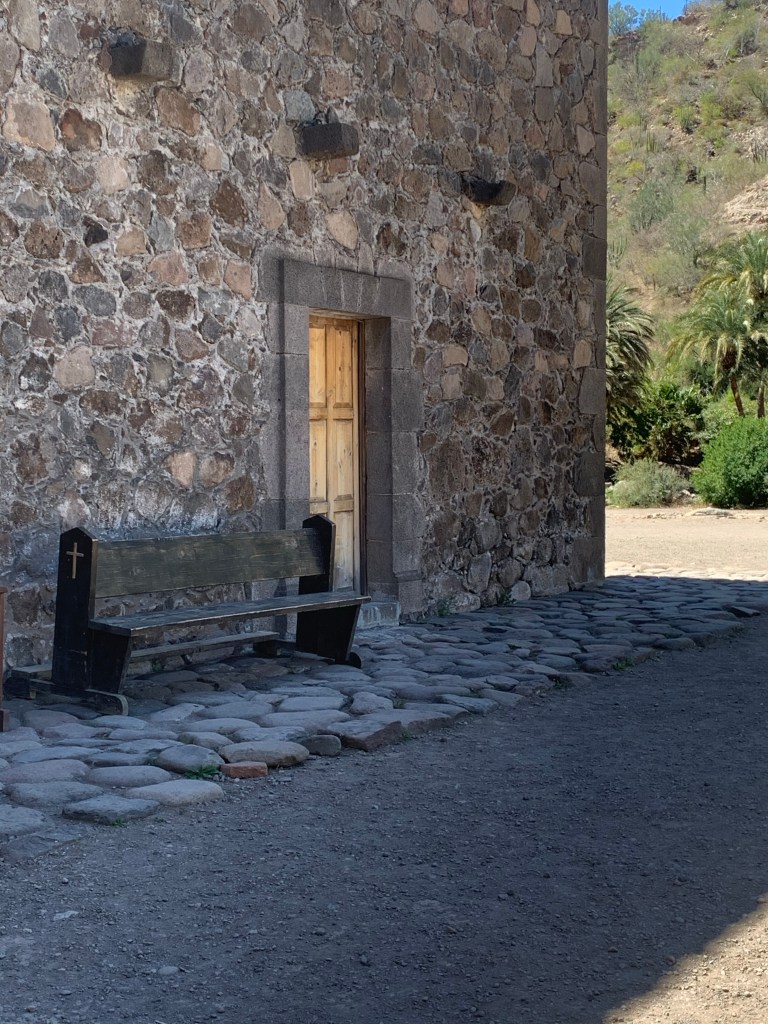
We arrange to meet Kim, AJ and their families for dinner on the Malecón at Los Mandiles, just before sunset. Meanwhile, JD, Lee, Kathy and I continue strolling the Plaza, and approach a large, wooden door leading into the museum (Museo de las Misiones) next to the Misión. We find it locked, although the signs say that we are within visiting hours. We press on the door, but it is firmly latched from the inside. As we turn to walk away, a man opens it, and tells me in rapid spanish (aided by hand gestures) that the museum is closed due to the wind. He invites us to come back tomorrow. We head for margaritas across the street at a nearby restaurant, Mi Loreto. While the ambiance from the street isn’t much, we enter to find a colorful array of mexican blankets and other decor, and are served a delicious variation of a margarita, served with pineapple and orange juices, and agave syrup. We return to our campers, and nap before dinner.
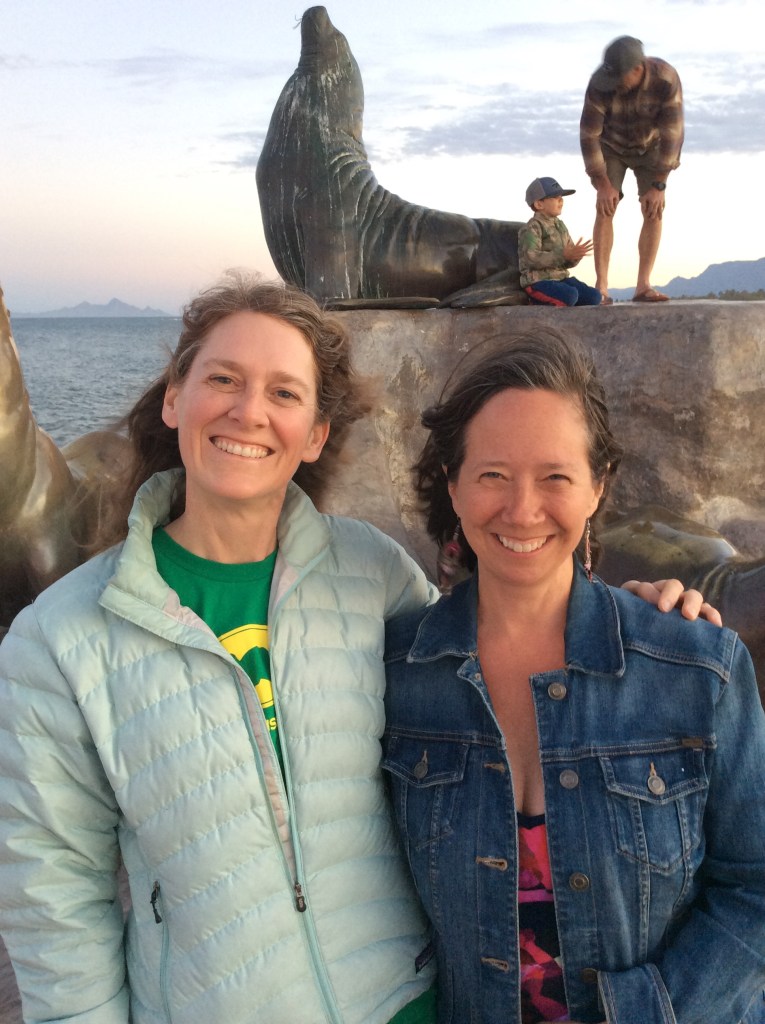
We reconvene with AJ, Kim and their families across the street from the restaurant, along the walkway lining the waterfront. Our large group walks out to the pier for sunset, separating naturally into pairs. Kim and I walk and talk like old friends do, topics meandering from work and family to our own physical and emotional well-being, and the intersection of all of these facets of life. We share challenges and celebrate successes, and I am reminded yet again of the gift of true friendship, delighted to have met up with her, here. We take photos at a sea lion sculpture at the piers end, and turn back toward the restaurant. This time, I walk beside Kim’s father, whom I learn is an avid sailor. AJ has just sailed his 26′ foot Catalina from Gonzaga Bay to Loreto, a passion that his father-in-law clearly shares. I tell Kim’s Dad about JD and my newfound love of sailing, our new (to us) sailboat Vishnu, my love of the feeling of being under sail, without a motor, harnessing the wind. I tell him about the book, “First You Have to Row a Little Boat”, by Richard Bode, and encourage him to read it. He seems interested, and says that he will.
Los Mandiles is standing-room only, which is a good sign. The proprietor nervously sizes up our 11-person group until he identifies AJ, and then breaks into a smile. It’s clear that he recognizes him, and as is customary down here, AJ had come by earlier to let them know we were coming.We are seated, and although dinner takes awhile (the owner apologizes that he is short staffed that evening), we enjoy rounds of conversations over drinks, chips, and very fresh guacamole. Kim and I are seated together; she shares that it is AJ’s birth mother who is here visiting – this is only their third time together since reuniting a little over a year ago. AJ and his mom are huddled close at their end of the table; this only enhances my gratitude for being welcomed into their precious family time. Dinner arrives, a bit late, but a splendid table of chile rellenos, mole poblano, enchiladas suizas, carnitas, arroz, frijoles, tortillas. We toast to friends and family, new and old. We close the restaurant down as we finish our meal, and bid each other goodnight. Our campground is just a short walk around the corner, and we head for home.
The next morning, Kathy and I head back to the Plaza for “girl time” – pedicures at a nearby salon! Meanwhile, JD and Lee wait back at the campground for our friends Ross and Kate, who are making their way back north, and plan to stay a night or two with us in Loreto. Kathy and I, freshly pampered, meet up with them all in the Plaza, and our group heads toward a local brewery with open patio seating under some shade trees. Its hugs and smiles all around, as we swap stories of our adventures thus far over tasty beers and French fries. After siting with the group for awhile, I notice my thoughts becoming preoccupied with my parents, and excuse myself to make a phone call.
I step out into the sunshine of the plaza to call Mom and Dad. I haven’t spoken to them since we left Punta Bufeo for Guerro Negro, when I told Dad that we would likely be out of contact for awhile, because we were going to see whales. I reach them and learn that Shannon, one of the nurses at their retirement/assisted living community, has just left from her daily visit to inspect the surgical bandage on his elbow, shattered in a fall a few weeks ago.
“Shannon always asks about you!” Dad says jovially. He tells me this is the first day that Shannon didn’t have to change the bandage; the swelling is down and his incision isn’t draining as much. I breathe a deep, silent sigh of relief. His tone of voice is good, he seems simply happy hear from me. I relax a bit more. It’s the small things, I remind myself, that really aren’t so small after all. He tells me that he isn’t in pain, and I allow myself to be grateful for it.
Dad asks about our trip to see the whales. Savoring the clear phone connection, I tell him all about the experience, resisting the temptation to over-simplify and shorten the story for Mom’s benefit, as we are learning to do, especially over the past few months. I tell dad about the sparkling clean ponga and the young Mexican captain, Raul; the two Mexican women who joined us aboard the boat; our first sight of whales in the distance; the mother and calf pair surfacing right alongside us; Kathy touching the calf, then me, then JD; lingering beyond our last encounter, savoring the experience, and saying goodbye. He responds enthusiastically with “Oh Wow!” and “Yeah!”.
As I conclude my story, Mom asks simply: “How is the weather where you are?” Her question is adeptly worded to camouflage the fact that she has no idea where I am. It has been years since she and I have had a real conversation. I long for the days when I would call, tell her about my challenges at work, and she would empathize in the ways that only a mom can. She, in turn, would tell me about her latest outing with her sister Sue, and how they laughed so hard that their stomachs hurt. But Sue is gone, and Mom doesn’t remember where I live, or that I’m no longer working. Early in her Alzheimer’s journey, Mom was very talkative during my phone calls home, forgetting (or perhaps disregarding) the societal expectations that work to keep a southern woman quiet and demure. It was as if she knew that time was short, yet still had more to say, and wasn’t waiting on an invitation to say it any longer. But now Mom, a retired speech and language teacher, has largely stopped talking during our calls, other than to ask about the weather. It is the one question she asks with regularity, her way of making conversation. I know that she has not followed my story about the whales, and has no idea where in the world I am right now – even though I tell her several times during every call home that we are “at our beach house in Mexico.”
Yet it has occurred to me that her question also has deeper meaning. For me it has come to represent an opportunity to also check in with my “internal weather.” To notice and allow whatever emotion is present, while trusting that, like external weather, emotions and states of being shift, seasons change, storms come and go, clouds form and fade. Like the country music song says, “Every storm runs out of rain.” And so, back in the present moment, I tell Mom that the sun is shining here, that I am sitting outside on a park bench, taking in the sun’s glorious warm rays. I know that she really wants to know I am safe and happy; I am both, and I tell her so.
And my smile grows stronger as I realize what Dad is also teaching me: to embrace joy, and share it through story. To set aside worry about all I cannot change; to lighten up and enjoy life‘s simple pleasures; to lift someone else’s spirits, and my own, by sharing something to make us smile. Like taking a drive to the dining hall with his wife. Like stopping to talk with a neighbor who has two Scotty dogs. Like talking about his breakfasts with “the boys”, and his grandkids, and marveling at the fact that today his first granddaughter, Ansley, will be 13. Dad is helping me to live life, embrace joy, and share it with those that I love.
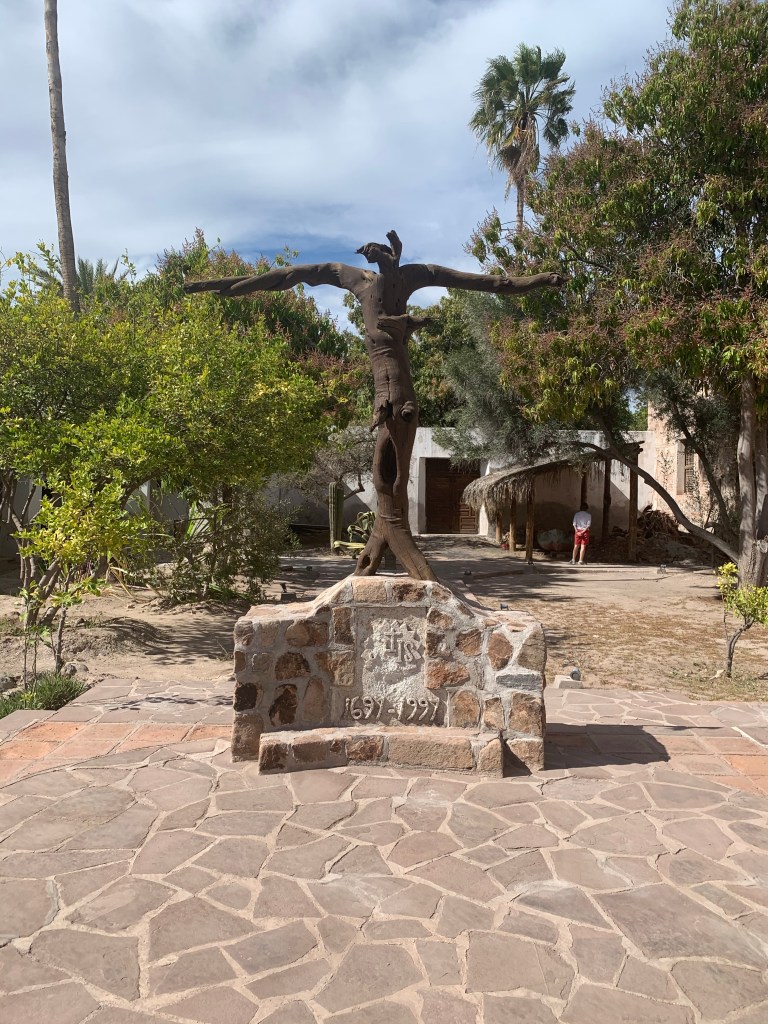
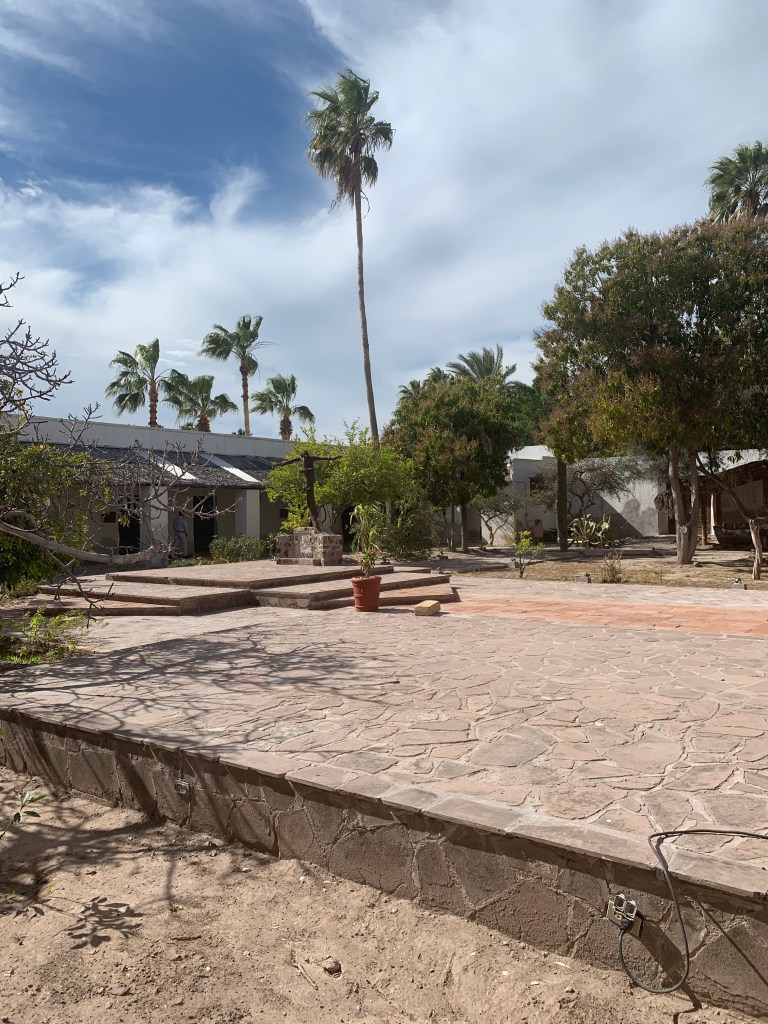
Reveling in the gift of a clear phone connection, I tell my parents I love them, and walk to rejoin my group. They are waiting for me, ready for more sightseeing. Lee and Kathy return to the campground while Ross, Kate, JD and I return to the Museo de las Misiones. It is open, and as we enter, it becomes obvious why it was closed to wind the day before: the museum consists of a building with a large courtyard, open to the elements, surrounded on all sides by small exhibit rooms. Today, the doors to the exhibits are all propped open; during a windstorm, this would damage the many precious artifacts, replicas, and interpretive signs – impressive in their design and detail, as well as the quality of the English translations. We pass from one room to the next, reading about the history of the missions – Loreto was the site of the first Spanish mission in Baja, although the original structure was destroyed in a fire. One of the exhibits demonstrates the process for extracting sugar from sugar cane; another displays a large, cast iron bell that once hung in the first, original mission, but disappeared, only to be rediscovered centuries later! One room has a life-sized replica of Jesus, lying on his back, crown of thorns around his head, arms at his side, legs crossed at his ankles. The wounds from his crucifixion are evident. While I have seen this image countless times before, I pause, considering anew the struggle, the suffering, embodied by this figure who simply wanted to teach us about love, kindness, forgiveness, compassion – and the tragic irony of the horrors that we have and continue to inflict upon each other in his name.
JD, Ross, and Kate, all former NPS rangers, are each impressed with the quality of the museum’s exhibits and interpretive materials. Lee joins us, and our group heads back to Mi Loreto for margaritas. We are joined later by Kathy, and we savor an early dinner consisting of delicious cocktails and a delectable meal of blackened fish, and steak and shrimp fajitas, in the ambiance of a covered canopy, a shade tree growing up through the restaurant floor, and the company of generous, attentive hosts.
After dinner our group returns to the campground, and JD and I walk to AJ and Kim’s house, across town and a large dry arroyo to the southern edge of Loreto. We arrive before Kim, AJ, and their parents have returned from a day at the beach. AJ tells us to press the call button on the security gate leading into their property complex. We do, and within a few minutes, an older Mexican gentleman in a cowboy hat drives up in a large, sparkling clean pickup truck. We identify ourselves as friends of AJ and Kim’s, and he directs us to AJ and Kim’s condominium – a vibrant, two-story prickly pear green condominium at the far end of the complex. We enter the unlocked front door to find a large, open floor plan with terra cotta colored porcelain floors, ceiling open to the outside, and covered balconies overhead. We navigate a set of stairs out onto one of the balconies, and wait while taking in their view of Bahía de Concepcion. Before long Kes, AJ and Kim, and their parents, return and we share a pleasant evening of stories before bidding them goodbye. AJ drives us back to our campground, and we encourage him to visit us in Punta Bufeo – an offer that we hope he and Kim will accept one day.
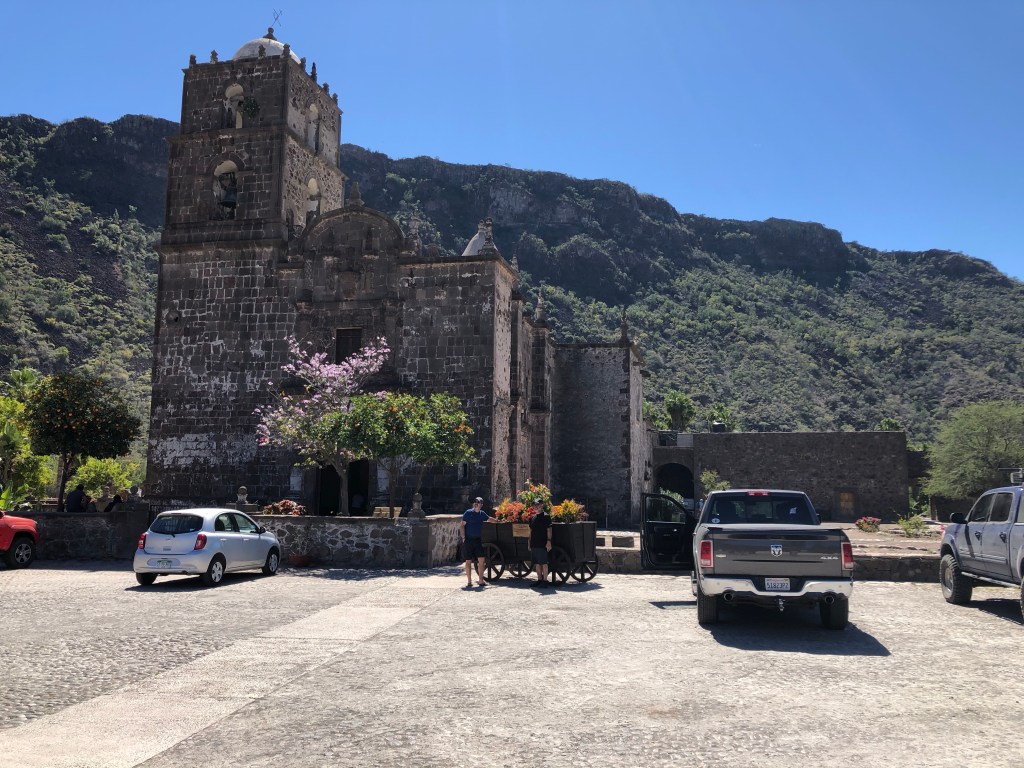
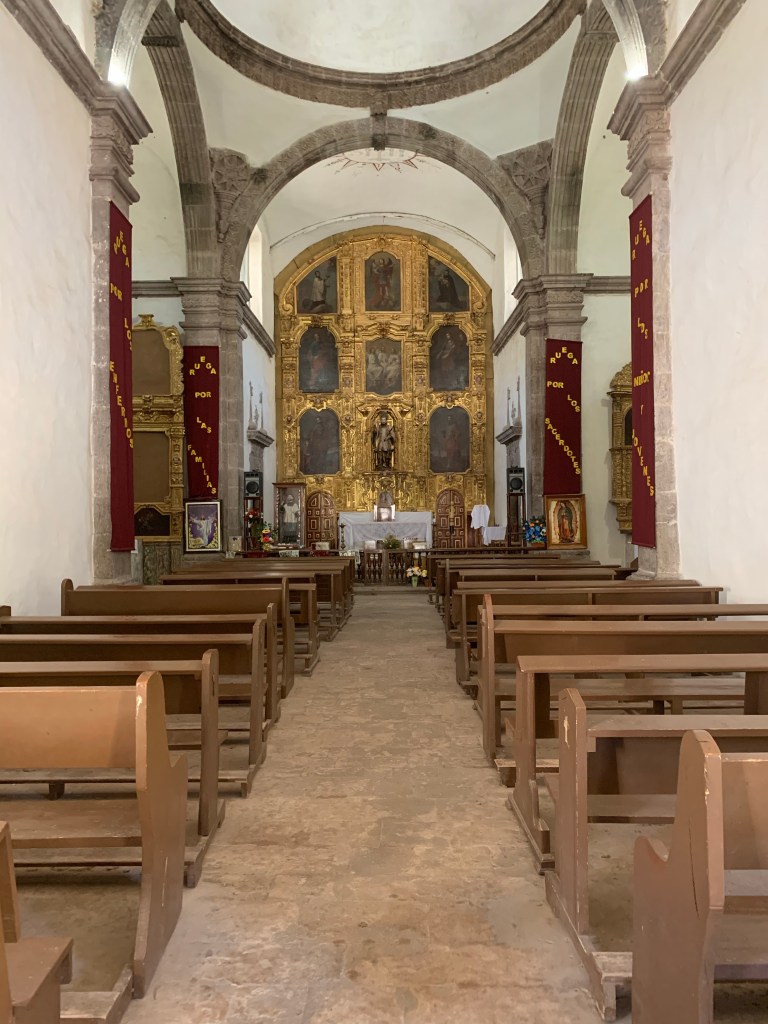
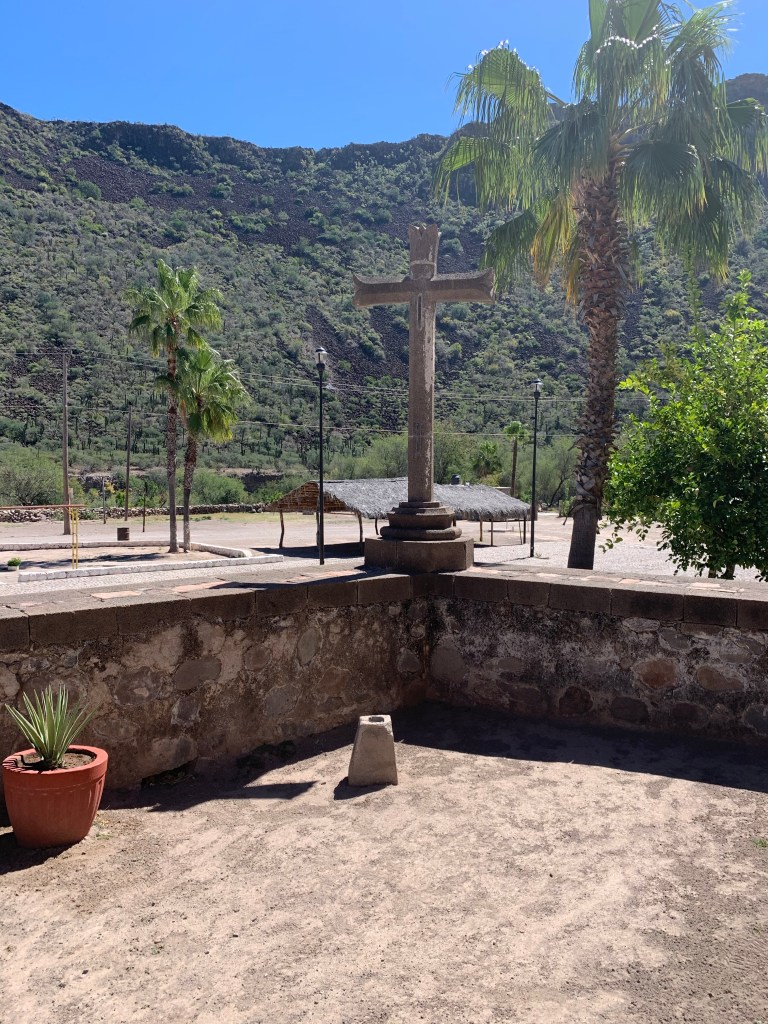
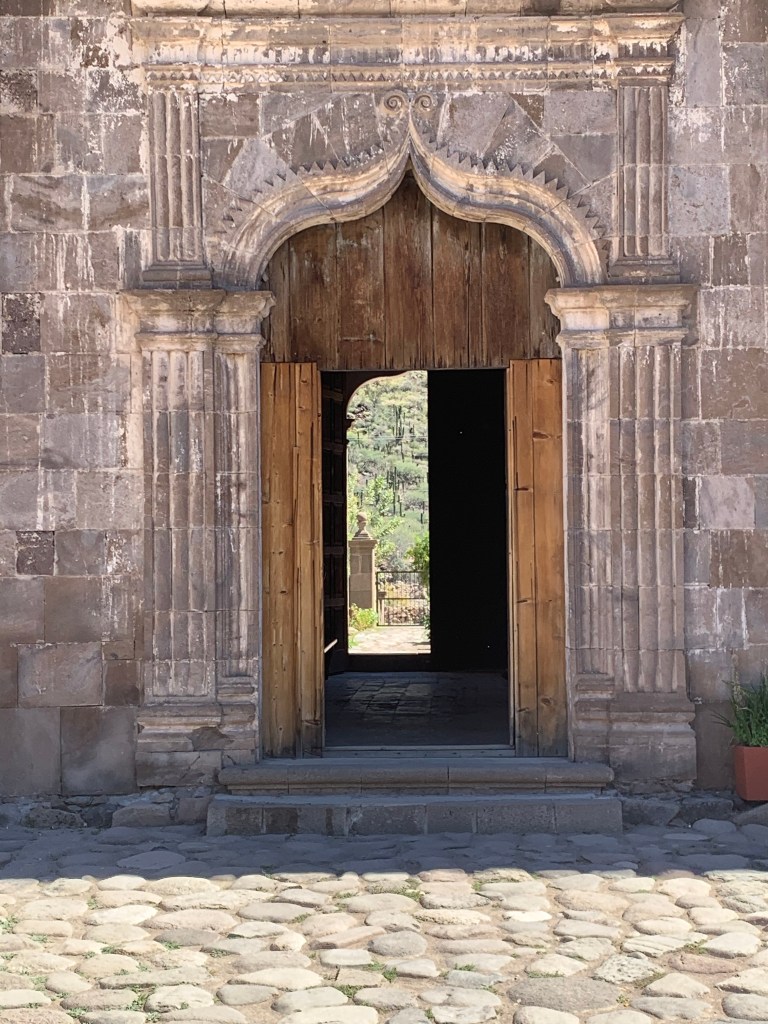
The next morning, Ross and Kate graciously offer us the use of their truck for a day trip up the long, windy, scenic route to the Misión San Francisco Javier de Viggé-Biaundó, just outside of Loreto. It is easier to unhook Ross and Kate’s Scamp camper from their Toyota Tacoma than it is for either of us to offload our truck campers from our larger rigs, and we we grateful for their offer. JD, Lee, Kathy and I load up in the Tacoma, and head out of town. The road is beautiful, the vegetation at times verdant, buildings and homesites scarce. We arrive at the small village of San Javier, just outside of the Misión grounds. The short, modest main street dead ends in front of the Misión, where we park and head inside. We are greeted by a man standing at a guest book, who invites us to sign, providing our names, ages, and home country. There are vessels of holy water on either side of the entrance; JD and I each dip our index and middle finger into it, closing our eyes and saying a brief prayer as touch our wet fingers to our forehead, sternum, left and right chest. We slowly approach the altar, on either side of which are shelves containing an array of white candles, some lit, some not, surrounded by paintings and figurines of the Virgin Mary, and other Saints whose names we do not know. JD asks me if I would like to light a candle. I say yes, and he finds a match book with two matches remaining sitting on the railing of the altar, itself adorned with a mixture of fresh and artificial flowers. We each light a candle, and again say a prayer, and I find myself moved to tears. I look up, self consciously, to see JD looking at me with a mixture of love and wonder. I place a donation in an offering plate, consciously embracing the countless paradoxes that surround religion and spiritual pursuits. No matter what names we use for it, or how we conceive of or worship it, or the countless ways we bastardize it and deny it, I know that at its core, this elusive and varied concept we call God is, simply, love.
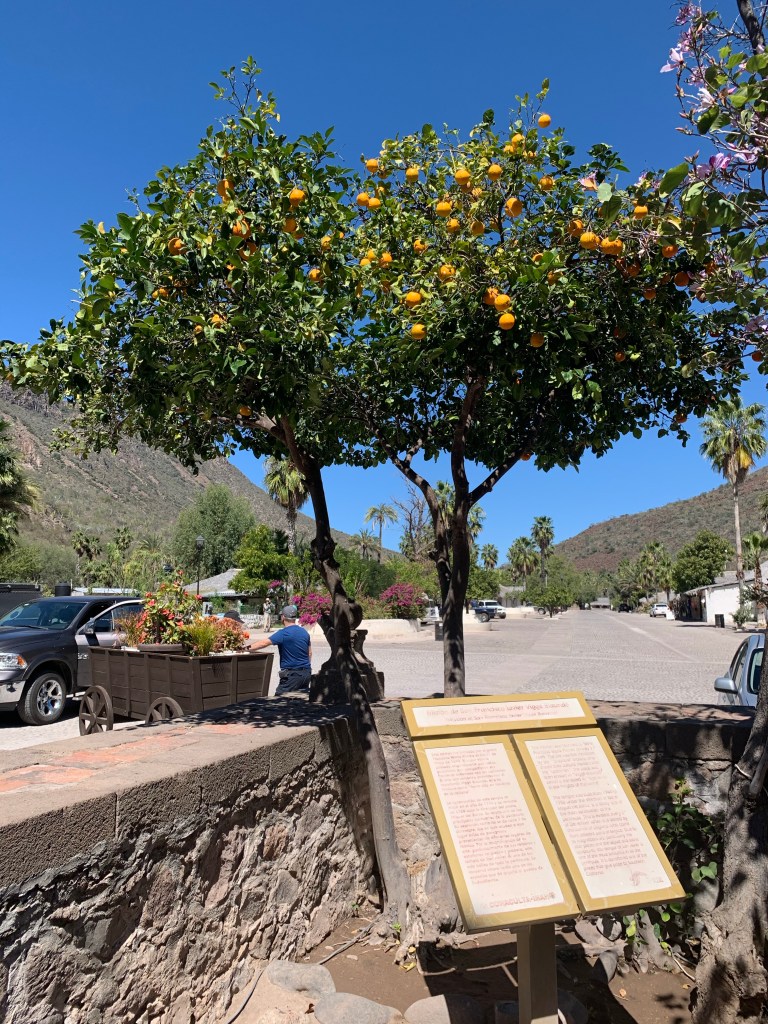
Stepping back outside into the sun, we appreciate the Misión’s grounds and landscaping, and take note of a man selling wares beneath the shade of a fruit tree. He has a small table, with a few bottles and some other food items on it. He is selling empanadas, pockets of flour stuffed with (in this case) either mango or papaya fruit filling. For $50 pesos I purchase a small bag of four, neatly wrapped in a clear cellophane bag tied with a ribbon, and share them with JD. They are delightful, with a crisp outer crust dusted with just a few grains of sugar, and interior of jammy fruit filling. I am reminded of the humble groundskeeper at the Mulegé Misión, and smile as the word “dulce” crosses my lips.
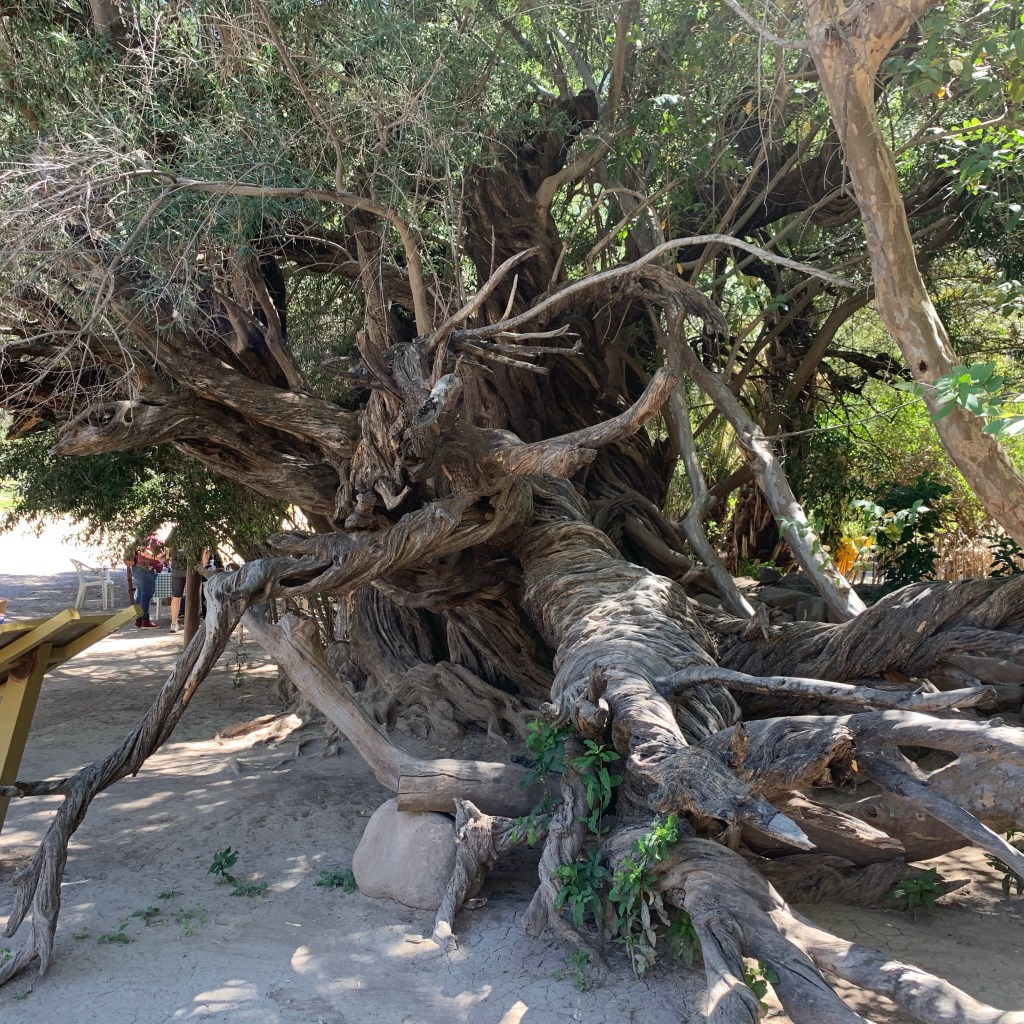
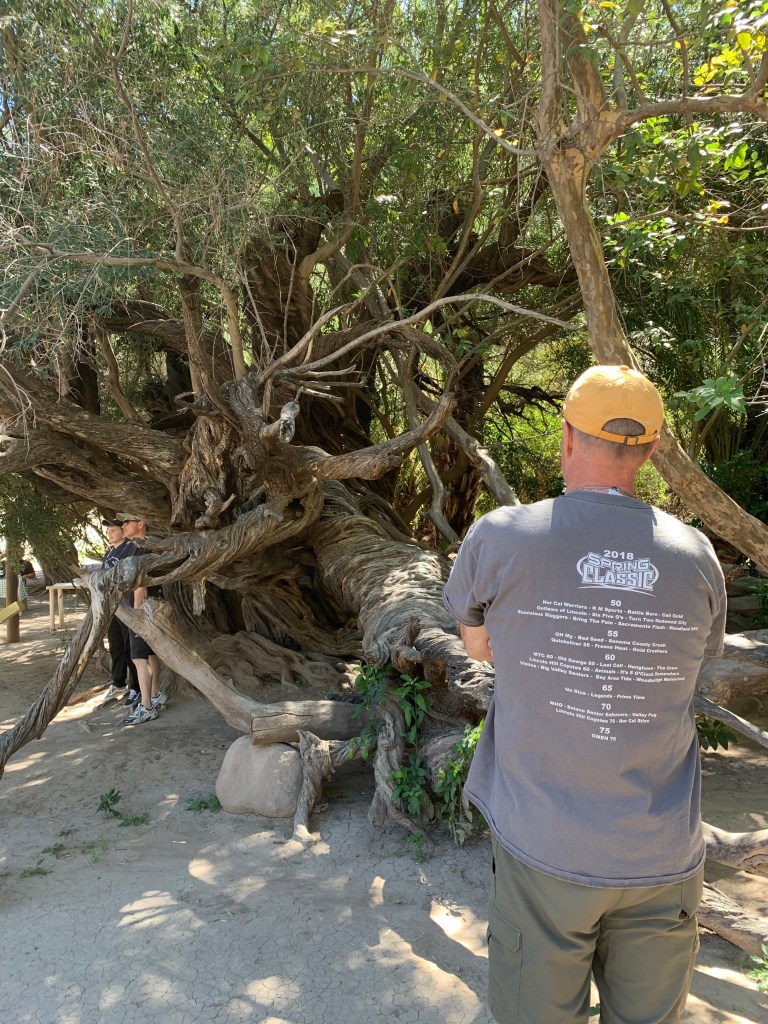
JD and I continue walking the serene, quiet Misión grounds, following a narrow, earthen path out toward an olive tree, reportedly several hundred years old. Along our route, we encounter a shade shelter with palm-thatched roof, beneath which another local gentleman sits beside a table bearing a guestbook, some carved figurines, and a bucket for donations. We sign his book, again providing our names, ages, and nationality, and provide a humble offering, It is clear that the locals have found a way to earn money by setting up stations along the tourist path, and we are happy to oblige. We exit the far end of this rectangular shade shelter, following the trail along the edge of a cultivated field to its end, at the foot of a giant, twisted olive tree. The tree is marked with an interpretive sign, and positioned by a modest fence. In the shade of its branches, off to the side, is another local couple, a man and woman, selling homemade wine. We respectfully decline, as we take stock of the large tree with its fat, curved branches, the bark winding and twisting around itself in an elaborate, mesmerizing pattern. An American family of three is there also: their young boy, perhaps 7 or 8, is attempting to climb its branches over the vocal opposition of his parents, who are having a hard time getting their son’s attention. JD walks over, slips effortlessly into ranger mode, and endeavors to educate the child about the tree’s age, and the impact that his footsteps can have upon this historical specimen. The parents appear to welcome the help managing their hyperactive son, and begin asking JD questions. I smile as I silently walk away, allowing him to share his gifts as I walk back to a spot beneath a large shade tree, where I sit quietly taking in this sacred space.
We reunite with Lee and Kathy out front of the Misión, enjoy a quick lunch, and make the drive back to the campground. That night, reunited with Ross and Kate back at Romanitas RV Campground, we feast on orzo and sautéed vegetables – a team effort by Kathy and me, cooking separately in our kitchens, then combining the ingredients into the finished product. Standing in JD and my camper, I serve each plate, passing it through the slot in our camper’s screened door, food truck style, to Kathy, who carries each plate to our guests who are seated in folding chairs near to the ground between our campers. Lee, Kathy, and I listen as Ross, Kate, and JD swap ranger stories. At some point in the evening, a stray dog approaches us, silent and quite timid, but determined. She is skin and bones, with a beautiful copper red coat. We offer her water, which she laps up quickly; within moments, she throws it up, clearly having consumed too much, too fast. She barely moves from the spot she has selected, on the ground in the center of our circle of camp chairs, at our feet. We offer her food,but she seems more interested in simply being in our presence, accepting the attention we are lavishing upon her. Our dog Pelli remains in our truck, either unaware or unconcerned. There are so many stray dogs in Mexico, its impossible to save them all, but as we found with Pelli, sometimes one just seems to find you, and if you make them yours, you’ll have the most loyal, grateful companion you could ask for. JD decides to name this newest stray “Koko”, thinking it might become Pelli’s other half. We leave food out for her as we retire for the night; when we wake, the food is gone, and Koko is too.
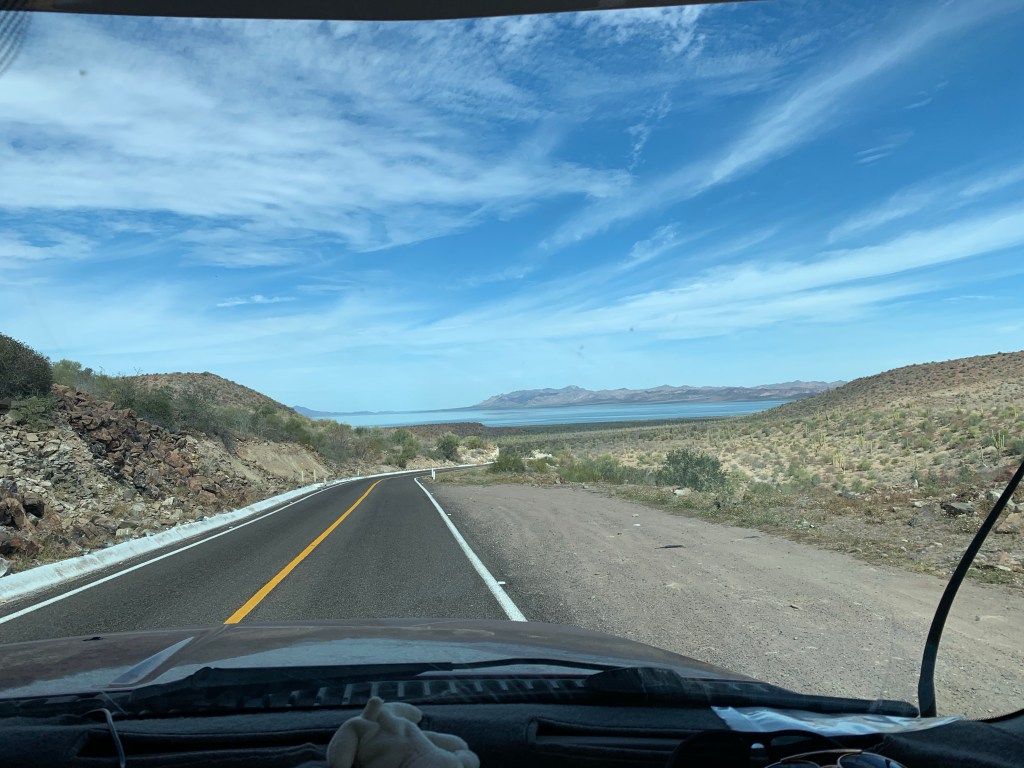
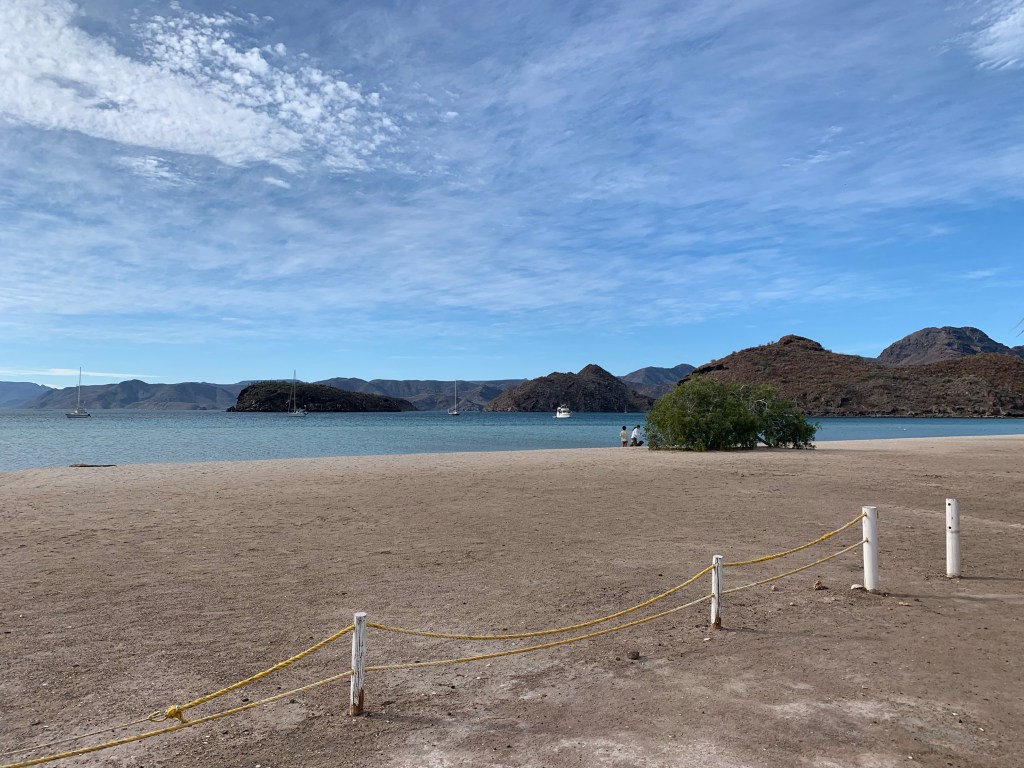
We leave the next day for our return trip to Punta Bufeo, eagerly awaiting the arrival of JD’s older daughter Anika, her husband Erik, their children Ember and Colter, and Erik’s parents John and Lori on March 7. As we make our way north of Loreto, the Bahía de Concepcíon comes into view on our passenger side. We peer over the guard rails (where they exist), staring in wonder down at the calm, lake-like, aquamarine waters, marveling at the many shades of blue from the shallows near shore (cerulean, sapphire, aegean, arctic) to the depths out toward center (teal, ocean, azure). As we pass the entrance to El Requesón, JD and I exchange brief, silent glances; the beach isn’t visible from the highway, and we keep going. But I can feel a sense of longing rising within my chest. Playa El Coyote comes into view, far below the highway; we spot the palapa where we stayed some nights before, and take note of more swimmers in the water than the wind would allow while we were there a few days ago. I begin to count down the last remaining beaches along the Bay – Playa Escondida, Posada Concepcíon…. JD and I discuss the water, how still it is, how inviting. Ahead of us, Playa Santispac comes into view, a large sandy beach with ample paplapas, two restaurants, and at least a half dozen boats – motor boats and sail boats – anchored in the bay. We brought daughters Anika and Kara’s stand up paddle boards with us, hauled all the way from Montana, for conditions JUST like this! We weren’t able to use them on our way down, the winds and sea were too rough. JD looks at me, asking if I want to stop. I hesitate for a fraction of a second, then shout “Yes!” just as we approach the entrance.
We pull in to the long, sandy approach road leading to the entrance station, and I hop out, running back to Lee and Kathy’s truck to ask if they’re OK with delaying our return by another night. They are, so JD pulls forward toward the shoreline to scout available palapas and campsites, while I stop at a building adjacent to the welcome gate, identified as the office. No one is there, so I walk to join the others at the trucks. There are perhaps 15 palapas on this long stretch of white, sandy beach, and every configuration of rig, from several 50 to 60-foot luxury RV motor coaches, to small, weathered sedans with well-used tents pitched nearby. We drive the full length of beach, and select one generously-sized palapa in between two large motor coaches, with enough room for both of our rigs. As we are getting set up, a Mexican vendor approaches, selling hammocks, woven porch swings, and sombreros. Although we don’t need anything he’s selling, my heart goes out to this man and how earnestly he is peddling his wares. We decline, and he walks on down the beach.
Camp chairs set up, our gringo neighbors in the motor coaches welcome us to the beach. We pull out the stand up paddle boards, and take turns inflating them using the hand-held pump. What a workout! We are grateful to have four people taking turns. Finally, boards inflated, Kathy and I don our life jackets, and carry the boards some 50 feet out to the water’s edge to find a not-very-inviting red algal bloom lapping at the shoreline. It is continuous along the entire beach, so there is no going around it, only through. We push it away with our paddles, which is only marginally effective, and mount our boards. And we’re off – paddling out amongst the boats, in the general direction of an island less than a mile off shore. We staying close to each other until we’re confident in ourselves, then begin to spread apart and explore the utterly still waters of the bay. I head toward the island, while inspecting the water beneath my feet – it is murky, speckled with millions of hay-colored droplets that could be fish fry, or another algal bloom, I’m just not sure. Whatever it is, it is throughout the water, as far as my eyes can see, and continues as I paddle along. Convinced that the water’s visibility is not likely to change anytime soon, I lift my eyes to the island out in front of me, and others behind it. As I approach the island, an osprey takes flight and passes 75 feet in front of me. I look in vain for signs of its nest; finding none, my eyes scan the numerous cardon cacti dotting the island’s surface. Pelicans are perched at the shoreline; seagulls fly overhead. I am tempted to circumnavigate the island, but it would take me out of view of Kathy and our boys back on the shore for quite awhile; I acquiesce and turn back for shore. I reunite with Kathy, and tell her I’m going to take the long way home, so I can paddle up close to some of the sailboats. I challenge myself to identify the parts of their anatomy: mainstay, mast, mainsail, jib, spreaders, boom, bow-pulpit, boom vang, main sheet. I admire their lines, their woodwork, their simple elegance at harnessing the wind. I wonder about their captains and crew. From where do they hail? Where are they going? How long will they be at sea?
Slowly I paddle back to shore; Lee has purchased shrimp and banana bread for us, from another one of the many vendors walking the beach. It is delicious. Our foursome sits in our chairs, reading and watching more boats come into the bay for the night. A large, yet graceful motorboat, hailing from San Carlos arrives, and drops anchor. JD’s interest is piqued, as he knows friends from there. After awhile, the captain and crew disembark, heading for shore in their dinghies. JD follows them in his binoculars, noting that they headed into a restaurant further down the beach. He proposes we follow, and see what we can learn. We walk to the restaurant, and find a large group assembled around a table, enjoying beers and cocktails. JD asks if any of them know Steve and Linda Holder, also from San Carlos. Initially, they look at each other, somewhat puzzled. They repeat the names to each other, and back to JD, before one group member says, pointing across the restaurant, “You see that girl there? She knows Linda Holder VERY well!” As they begin to laugh, their companion walks back over to us, and confirms that yes, in fact, she knows Steve and Linda both. JD explains that the Holders are old Park Service friends – Steve also married JD and me. Small world! JD swaps stories and we take a picture for them to show Steve and Linda, to remind them who they met at Playa Santispac. Unfortunately, we neglected to get their names or a copy of the photograph!
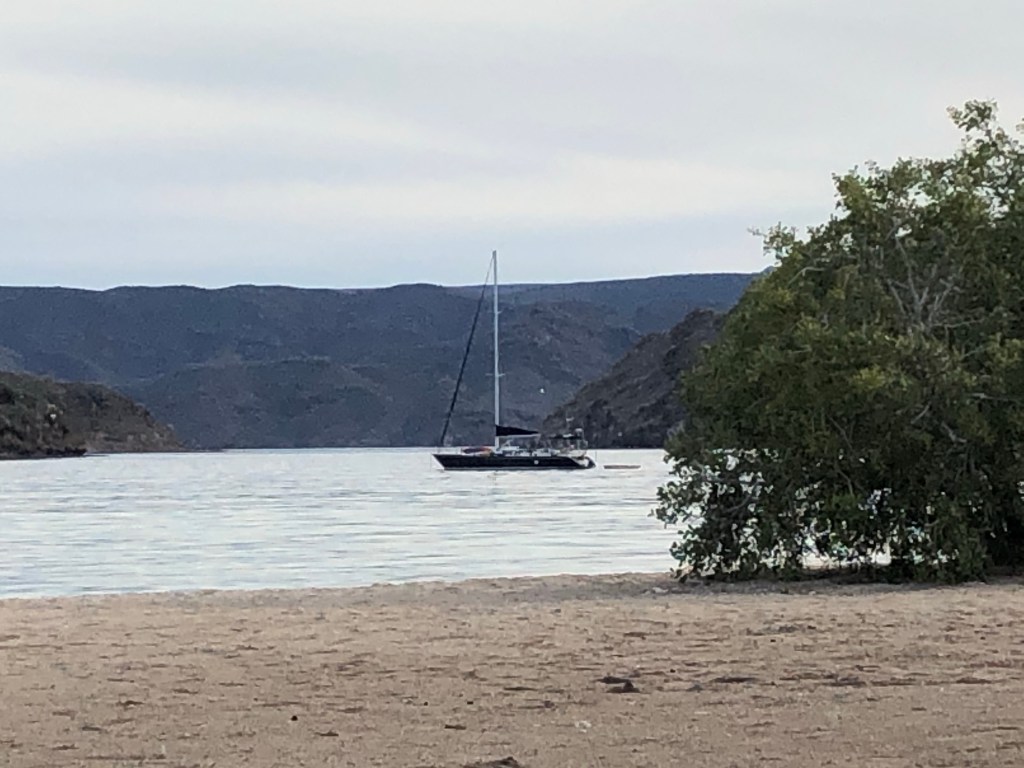
Back at our campers, we have cocktails as we watch yet more yachts come in. We particularly note a sailboat, perhaps 35 feet long and an impressive mast towering many feet above most others, coming in under motor, with seemingly only one person aboard. The lone captain stands atop the bow, no shirt, hands calmly and confidently clasped behind his back, taking in the water and shore. How is he maneuvering such a large sailboat alone? I stare in amazement. JD notes that he is adjusting the motor from a compartment in the bow in order to drop anchor. No matter, it is still impressive, and the captain knows it. We commend his skills as the boat slowly, gracefully, comes to a stop.
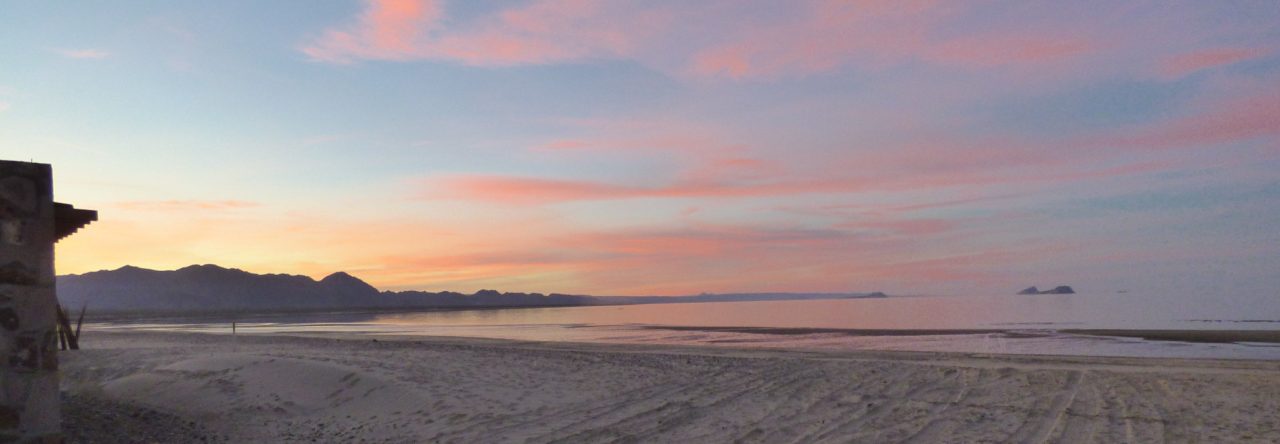
We enjoy a beautiful sunset, and as dark falls, JD notices something different about the waves as they gently lap on the shore. Venturing out to the water, he reports back that there is bioluminescence in the waves!! The phenomenon is due to the presence of marine plankton – dinoflagellates – and a chemical reaction within their cells that causes the ocean to sparkle and glow at night. We have only seen this phenomenon once before in Baja, on the shore at Punta Bufeo, several years ago. Wherever, whenever it occurs, you can expect a surreal, nearly psychedelic experience, that most first-time observers will struggle to believe. We stand at the waters edge, kicking the waves up toward the sky, exclaiming with glee as the water instantly comes alive at the site of each disturbance, studded with luminous blue-green diamonds raining back down into the surface of the pitch black ocean, and spills out onto the adjacent sand beneath our feet. Over and over and over we kick, as if to convince ourselves this is really real! Lee finds a bail bucket, plastic, gallon milk jug in a nearby ponga anchored on the shore, with its top cut off, the handle still attached. He hands it to me; I playfully scoop water out of the waves, tossing it high into the air, squealing with delight as the water from my bucket crashes back down into the surface of the ocean, exploding each time into iridescence even more magical, if its possible, than the stars above.




 If You’re Lucky Enough: Carolyn and JD’s blog