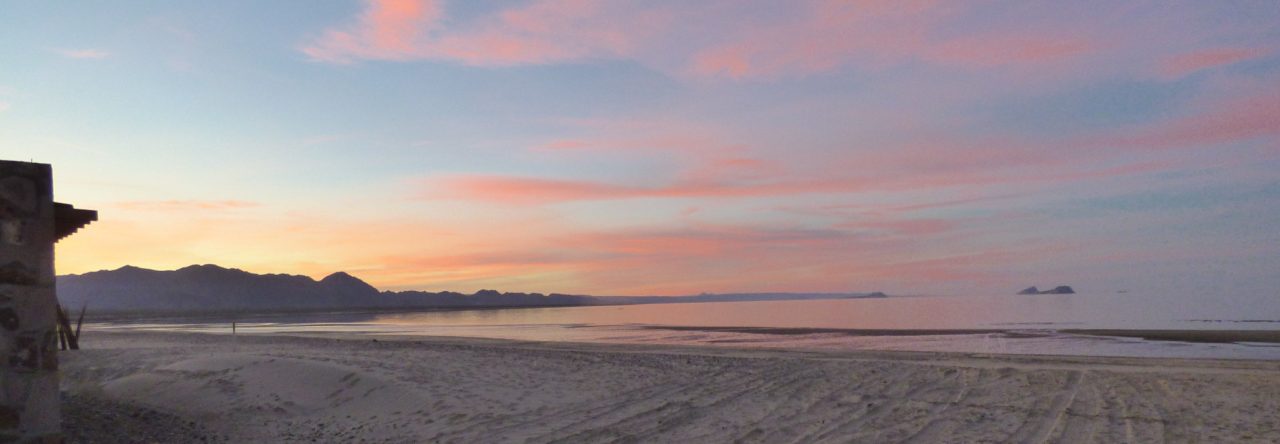
Following a majestic few days camping at Ojo de Liebre, and going out to visit the Gray whales nursing their young in the protected lagoons of Baja’s Pacific coast, we head further south along the Baja Peninsula, crossing back over the to the Sea of Cortez. We plan to stop for a few nights in Mulegé, unanimously described lush, palm oasis in the desert, as well as a popular tourist destination (and retirement spot) for many American and Canadian gringos. We pull into town just before sunset, and navigate the narrow city streets (once again, our truck campers are among the largest rigs on the roads) toward our destination, Huerto Don Chano RV Park, recommended by Ross and Kate, now several days ahead of us along their southbound route down the Baja Peninsula. We find Don Chano’s on the far edge of town, close to the sea, and are directed by the host to two spots on opposite ends of the modestly-sized, well-shaded RV park. After parking, leveling, and opening up our truck campers, we inquire among the other campers about a place to eat. We learn that we have just missed the weekly pig roast – bummer! – but are given a dinner recommendation within walking distance. We stroll a sidewalk along Calle Playa, paralleling the Mulegé River as it flows out to sea, following the sound of live music playing classic rock. Before long we arrive at a small, outdoor bar with a live band and lots of gringos dancing. We stay for a beer (or two), then continue along our route to our dinner destination, arriving at last light.
We enter the restaurant, located on a point on the north bank of the Mulegé River as it empties into the Sea of Cortez. The place is humble, equipped with a gravel/sand floor and unpainted plywood walls, a palm-thatched roof, and a total of maybe six white, plastic, sets of outdoor tables and chairs, draped with festive, colorful, Mexican blankets. A small but seemingly well-stocked bar, adorned with festive string lights, beckons us in. We are the only patrons. No wait staff greet us, but the lights tell us the place is likely open for business, so we help ourselves to a six-top table beside a large window looking out on the water, less than 10 feet away. Within minutes a waitress comes to supply menus and take our drink orders. We enjoyed a great meal of camerones rancheros, tacos de pollo, tortillas arroz, and frijoles. Only the margaritas were a disappointment – made with Fresca or limeade, not sure which, but we have since learned this is a popular (but not particularly tasty) version of this drink on the Baja. We walk back to our campground in the dark, and bid each other good night. JD and I wake and walk to Lee and Kathy’s camper; we find them drinking coffee, and learn they have already eaten breakfast – a man selling hot (well, warm at least) tamales stopped by their camper soon after sunrise! A great start to the day.
After pondering our options, our group opts to head further south for Loreto, by way of Hotel Serenidad, on the other end of town. Our friend Ross (the scout) has reported they serve “legendary” margaritas there, and encouraged us to stop and explore this former haven for Hollywood movie stars “back in the day”. We do stop, and find Ross’ report to be wildly accurate – the best margaritas we’ve had in quite awhile! After a splendid lunch of fresh guacamole, chile rellenos and camerones Mulegé (a local variation on Veracruz), we decide to stay the night in the RV campground immediately adjacent to the hotel. The Hotel is quaint, beautiful, delightful. After our meal, campsites secured, we linger by the outdoor swimming pool, just a few feet from our lunch table on the covered outdoor patio, beneath the palm trees. I lay back onto the porcelain tile lining the pool, opening my eyes to the brilliant blue sky above, with tendrils of feather light clouds, and my ears to the mesmerizing sound of wind tussling through the leaves of the palms. I could sleep here for days. That evening, we return for a “light” dinner, of shrimp skewers, chile rellenos and margaritas. The food is delicious, I think possibly the best I have had in all of Baja.
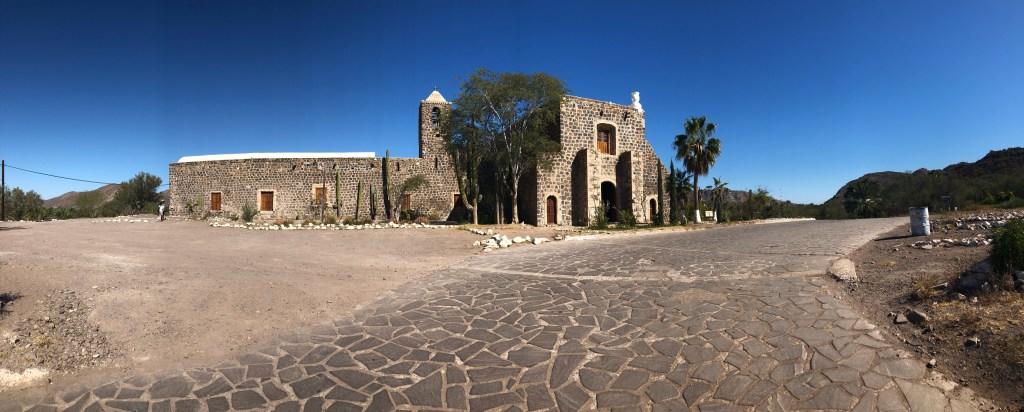
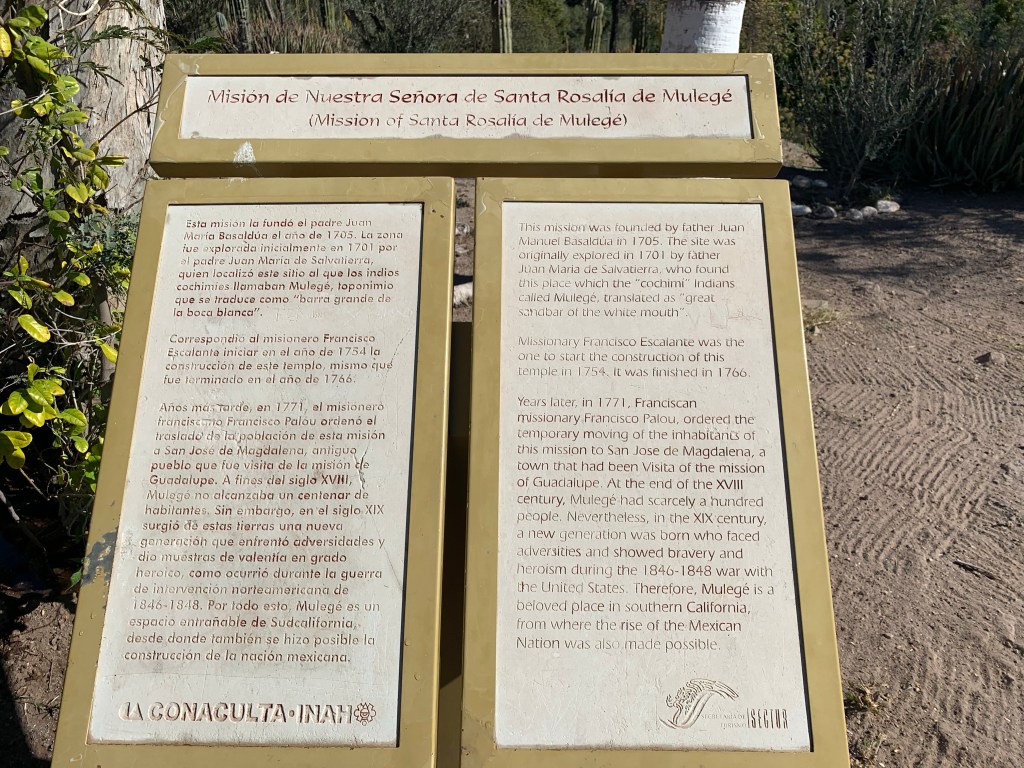
The next morning, we inquire at the hotel front desk about a taxi to take us to Misión de Nuestra Señora Santa Rosalia, and an historical prison, now operated as a museum. As I complete the taxi request, I am again delighted to be getting so much Spanish practice, as the further we go southward along the peninsula, the less English is spoken by locals. Our taxi arrives, and within 15 minutes drops us at the Misión, situated high upon a hill top overlooking the Mulegé River. We are immediately greeted by the groundskeeper, a thin, tan, wiry Mexican man who is watering the modest, but immaculately kept, landscaping. He speaks no English, but clearly regards himself as our appointed tour guide, and wears a laminated identification badge around his neck that seems to substantiate his role. He stands close by as we read the welcome signs, then respectfully bows his head as we turn to enter the sanctuary. We walk toward the altar individually, each at our our pace, each stopping to sit for a moment on one of the pews, some of us bowing our heads in prayer.
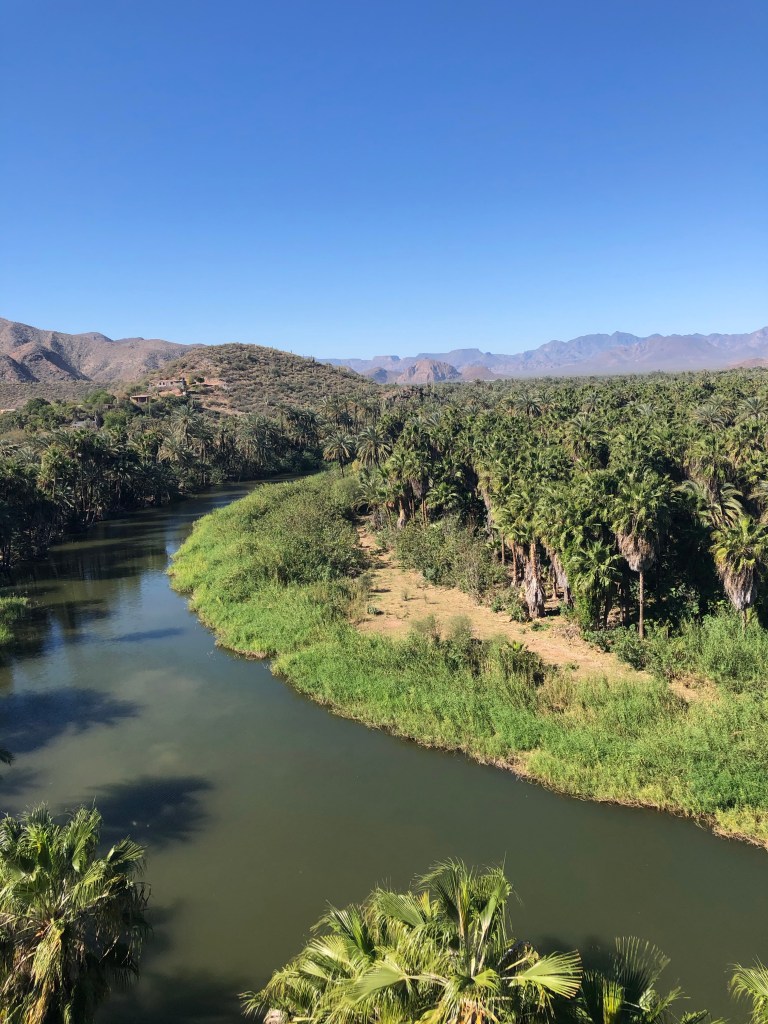
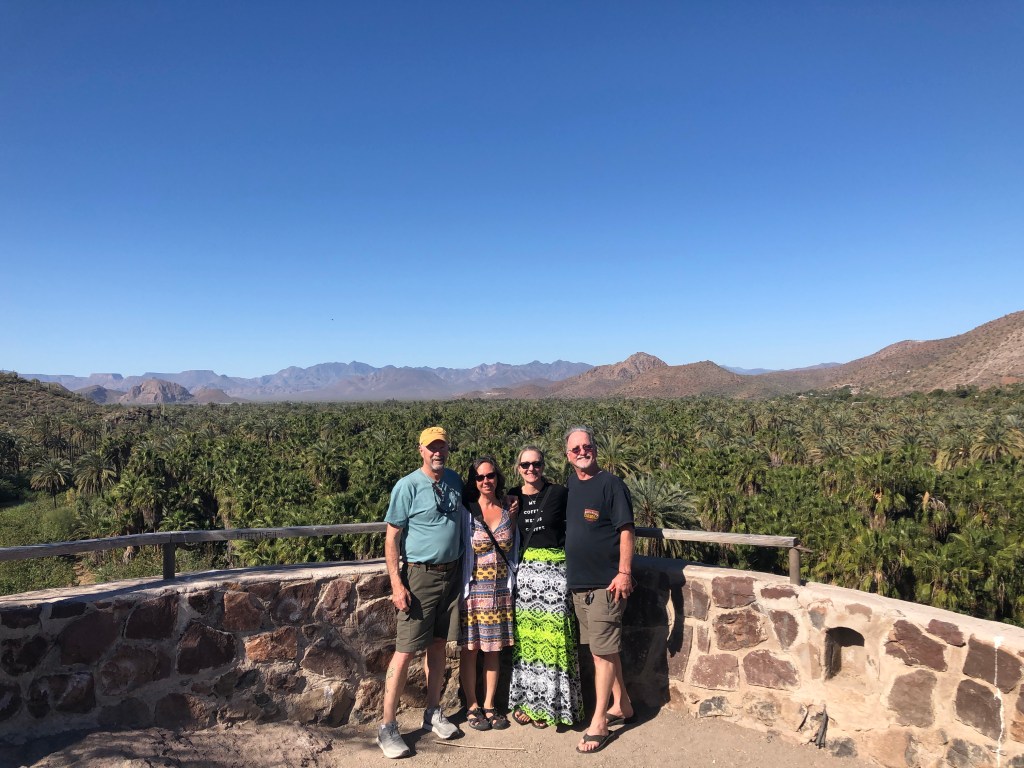
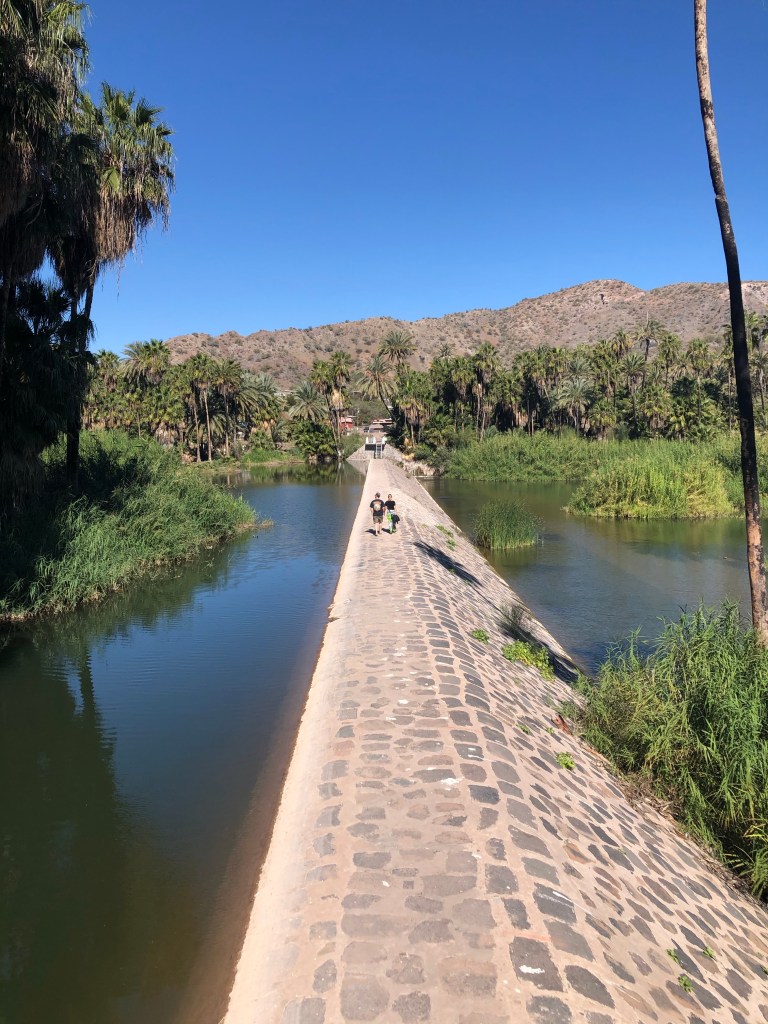
We emerge and walk the grounds. Our guide is exceedingly soft spoken, gentle, humble, yet insistent. He takes us to a nearby vista, overlooking the silver and date palms lining the river corridor below. From high atop the overlook, he points down to the water coursing through the river, and says simply “dulce” (translation: sweet). His eyes and voice convey immeasurable gratitude for this abundant fresh water source, the largest I have seen anywhere on the Peninsula, such a gift of life for this desert landscape. We tip him as we leave, heading on foot across the top of a small masonry dam that also serves as a pedestrian bridge to the other side of the river, leading into town. Stopping a few times for directions, we make our way to the prison, also located on a highpoint on the opposite bank of the river. There, we are greeted by two volunteers, from whom we learn that the prison was the oldest on the peninsula and housed both men and women. It operated under an honor system, in which convicts were released daily into the town to work, with the expectation of returning each evening. Dangerous criminals, particularly murderers and rapists, were not granted this privledge. The honor system was effective because if you violated any rule you were sent to a much more bleak prison, where many inmates died. I neglected to write down the exact date, but I recall our hosts telling us that prisoners were detained there until the early 1970s!
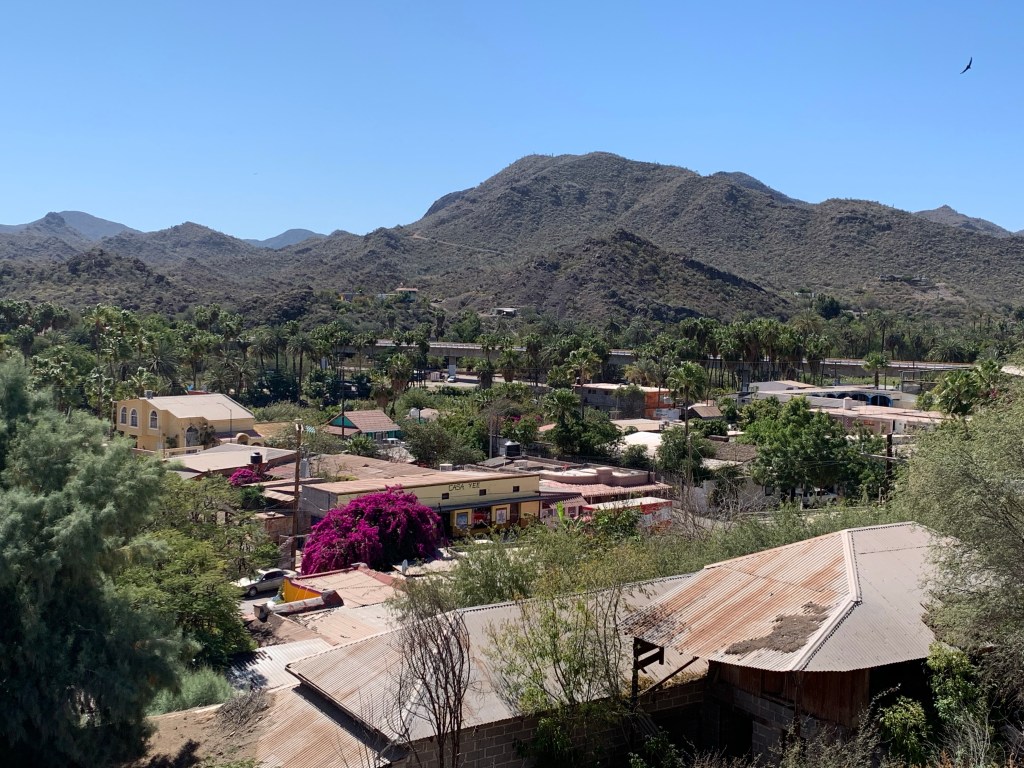
We did our time at the prison, and left on foot, wandering back down into town, where we purchase a few souvenirs at a local fish and tackle shop. We stop for lunch, and secure a taxi back to the hotel, where we retire early amid plans to head to Loreto in the morning. I am growing excited for the prospect of meeting up with two friends of ours there, from Reno – also seasoned travelers in Baja.
Along our route southward from Mulegé, we stop for a night along the sandy beaches lining Bahía de Concepcíon – perhaps my favorite landscape in all of Baja thus far. Beautiful blue, aquamarine waters lapping sandy “biological beaches”, meaning the sand is derived from seashells that have been pulverized into tiny pieces over the millennia, as opposed to sand that is derived from stone. We approach the first beach, Playa Santispac, to find a Caribbean-like scene: a semi-sheltered bay of brilliant aquamarine water, palapas was palm-thatched sides and roofs, and… sailboats – lots of them – anchored out in the bay!! I’m simply enchanted. I ponder their occupants, their stories. Where are they from? Where are they going? How long have they been at sea? Could JD and I – would we – ever attempt such a feat? How elegant their shapes, lines, colors, bobbing in the water. I think of our little 19 foot sailboat, Vishnu, back in Montana. Our weekend of American Sailing Association (ASA) sailing instruction at Flathead Lake. I hope we will continue to learn the art of sailing. It mesmerizes me.
But Playa Santispac will have to wait, as we we are headed for El Requesón, recommended by a Canadian couple that we met in Mulegé. They assured us that each beach along the waters of Bahía de Concepcíon is beautiful in its own right, with a different feel, different personality. We find this to be the case – each beach that we pass IS beautiful, and while some have no human structures at all, most have at least a few palapas, whereas some are also equipped with restaurants, even houses. Most of the beaches that we pass are filled with people. We pull into El Requesón, finding the entrance paved as described, for a short stretch, before the pavement gives way to sand. Meanwhile, the winds are picking up fast. The approach road takes a sharp left turn as the vegetation opens up to a full view of the water, and a long, narrow spit of sand leading out to a small island fringed with mangrove trees. The beach is smaller, further from the highway and generally more remote than the others, with less facilities. Nice in every respect, and but also popular, with few palapas, and seemingly less room for two more truck campers like ours. We stop at the lean-to shelter comprising the host station, and ask if he has a palapa for rent. No, he says, they are all taken. With daylight waning, we opt to backtrack to one of the other beaches we passed, and see what we can find for the night.
We spy a vacant palapa at Playa El Coyote, just a few kilometers back up the road. We navigate over, staking claim to the palapa by the shore, the edges of our truck tires within four feet of water. Few if any places in the states would allow parking and camping in such close proximity of the shoreline! While I am thrilled by the novelty of it, the amazing view right beneath our feet, my stomach tightens with the knowledge of the impact that so much traffic is having on these precious sandy shores, the habitat that is being disturbed or lost. But, knowing that Loreto is still hours away, and accepting that this is not only allowed but customary here, we park our truck in tandem with Lee and Kathy’s along the shore, and claim the last remaining palapa on the beach, at $200 pesos (roughly $10 US) per truck per night.
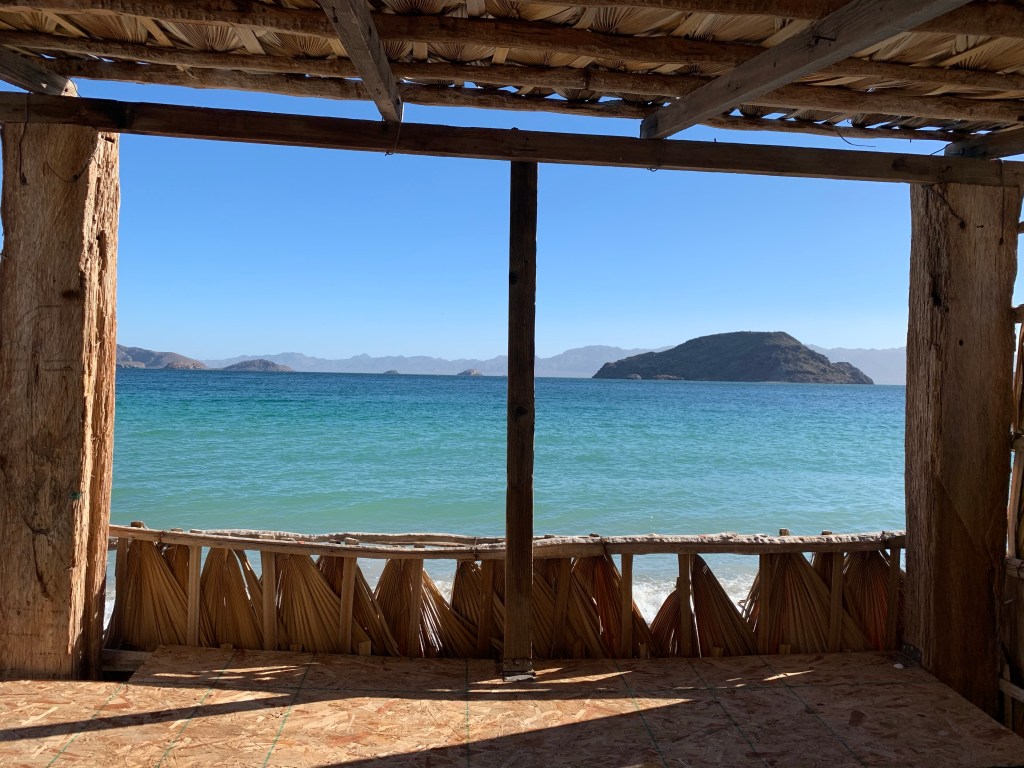
Despite the winds, which are strong enough to make siting outside unpleasant, we hunker down inside our four-sided palapa. The water is just barely visible through a waist-high, rectangular window. Kathy and I sit in our folding camp chairs, talking about our mothers. Kathy is still in the early stages of grief, having lost her mother just barely a month ago. My mom’s dementia makes her feel painfully distant, even when I’m right beside her. I have been grieving this for years; however, as we talk, I notice and tell Kathy that the intensity of my grief is less – when they come, the waves no longer cripple me, bringing me to my knees in tears. Rather for now, at this moment, it is bittersweet – I can hold sadness alongside of profound gratitude for what was, is, and will be. This realization nurtures my faith that I am learning to be resilient enough to lean in to love, and let it go, wholeheartedly. I don’t want to close up my heart as a result of the excruciating, at times debilitating pain that comes with death. Rather, I want the acute awareness of that pain to pry my heart open further still, not shying away but rather, leaning in fully to each moment spent in the company of those that I love – savoring it fully precisely because I know that it will not last forever.
As Kathy and I talk, JD and Lee take a walk on the beach, and return with a warm pizza! Apparently, an entrepreneurial Mexican man who owns a bakery in town periodically delivers baked goods to the beach. Cinnamon rolls on Fridays! Too bad it’s Wednesday. But meanwhile, we’re happy – pizza delivery at our doorstep, for $10 US! We are delighted. I can’t remember a warm(-ish) pizza ever tasting so good. We retire early to our campers shortly after eating. JD helps me edit and finish our blog entry on Jose, and we head to bed, spooning as we listen to the waves just inches beyond our truck tires, out the camper window. The wind is howling through the canyon above our heads, but I sleep peacefully in his arms.
JD and I wake at first light, and he asks if I want to get up to watch the sunrise. I respond with an enthusiastic yes (he isn’t usually an early riser), and he gets up with me. We walk northward on the beach until we are able to get a view of the sun coming up on the horizon. While walking we discuss possibilities for a Razor (OHV) ride with Lee and Kathy; as we stop to take in the view, I gently ask him to be quiet while we watch the first glimpses of the sun emerge over the mountains far on the other side of the bay. He heeds my request, allowing me to wrap my arms around his waist. He often says I would crawl inside of his skin if it were possible, as I work to seal any gaps between us as we embrace. Punta Bufeo hoodie pulled up over his yellow “Fins and Feathers” ball cap, I nuzzle my head into his chest, eyes facing the sun rising over the water. As the first rays of sunlight hit the water, he remarks quietly, simply, “diamonds on the water”. I smile, silently as the orange rays of light give way to pink and red, encircling the sun.


 If You’re Lucky Enough: Carolyn and JD’s blog